
8 Asians

Asian Medical Hazard: Mongolian Spots

| |


“What are those?” I asked as I pointed to bruiselike, blueish black patches on The Daughter as she was being examined by her pediatrician.

“Just Mongolian spots,” replied the pediatrician.

“But we’re not Mongolian!” I said, surprised.
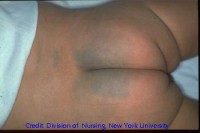
mongspotWhether you are Mongolian or of some other Asian descent, Mongolian spots can be a real hazard.  Some 90-95% of Asian babies are said to have them.  They aren’t a direct threat to a baby’s health, but as attested here and here, they can be the cause of false accusations of child abuse, with children even being taken from their parents by Child Protective Services when the blueish black spots are mistaken for bruises.  They typically fade away after a few months or years.  Some adoption support organizations recommend that if you adopt a Asian (or any other ethnicity) baby with Mongolian spots, that you have this well documented.  I can’t imagine what kind of anguish a parent would feel to have their baby taken away over something totally not their fault.

The Wife and I never had any problems with our three kids because of Mongolian spots, most likely because they never were in daycare as infants.  It’s also worth mentioning that African-Americans and Hispanics commonly have them, and some 10% of white people have them.  I even found an story about an African-American mother who really wanted to find one on her son.   Given some of the above incidents, it’s probably a good idea to have Mongolian spots documented in a baby’s medical record no matter what ethnicity that baby might be.

What next?

  • Subscribe to this feed
  • Leave a comment

12 Comments to “Asian Medical Hazard: Mongolian Spots”

  • I’m Chinese and my husband is Korean. Both of our children have Mongolian spots (though our oldest son’s spots are almost gone – he’s three-and-a-half). You should be aware that Mongolian spots don’t only appear on the buttocks and lower back. They can also appear on the shoulders. Both of our kids have Mongolian spots on their lower backs, bums, shoulders, and my youngest has one big Mongolian spot on the side of his elbow on one arm.

    When I was pregnant with our second, I was reviewing our first-born’s birth records and realized that his Mongolian spots were not recorded. Since we were seeing the same health-care provider (a registered midwife), we asked her if she remembered his spots when she helped deliver him (she did), then asked her to add a note to his birth records by adding the missing information.

    She said she couldn’t do that, but if there was ever an investigation that we could just take him to a doctor. Apparently doctors are trained to be able to tell the difference between Mongolian spots and bruises.

    We never had to deal with someone mistaking our sons’ spots for bruises and accusing us of abuse (he also never went to daycare). Still, I’m very glad that our oldest son’s Mongolian spots have almost all disappeared. And we were very diligent about making sure our second child’s Mongolian spots were recorded in his birth record.

  • So THAT’s what they’re called. Back when I was a baby, my parents were one of the unfortunate ones that had the authorities called on them because they thought I was being abused.

  • If I remember correctly from my job in genetics, mongolian spots (the correct terminology has it actually lower case, not upper case) can also be a sign of a spinal malformation which in turn can be attributed to different genetic syndromes. Genetics physicians are trained to spot the difference as well, since some of these syndromes can be pretty bad in terms of management and prognosis.

  • my sister and i had them!!! and i still have mine!! ahhh! my mom uses it as proof that i never grew up.

    am i the only adult who has this still? :(

  • I remember having the blue/green butt as a young child, and how it slowly faded away. Wow, I hadn’t thought of that for a really long time.

  • I never ever knew that people would get in *trouble* for that. It’s common knowledge, or at least I thought it was. I’ve heard stories from EVERY culture about those spots, so I naturally assumed that people wouldn’t mistake them for bruises. My kids were in daycare and never ever were questioned for those spots. Sad that some people go through that. *shaking head*

  • efren i also do work in genetics, my research is more on stem cell therapy and pharmacology. Can you suggest some early tests such as gene chip “link location/firm” and or treatments to prevent adolesent disabilities or symptoms. thanks in advance

  • I believe it is mostly an Asian characteristic, although my mother (eastern European) had it all her life. My daughters are adopted from China, of daughter #1’s adoption group of 12, over 1/2 had it (#1’s is gone now)

  • Does it serve an evolutionary purpose? I find this to be a very curious thing, and I am humbled by just how much I don’t know about the world still. Was this a trait selected for in the history of Asian sexual selection? I have never heard of such a thing before.

    Tim

  • I’m pretty sure that this is a tall tale, rumor/legend with little or no scientific value but I heard that these spots were a result of our ancestors….generation after generation riding on horses or other animals, later on developing them as a side-effect. Like in general, a trait we developed overtime due to the increasing sedentary lifestyles we were pursuing. It may or may not have any truth in it but I thought it was worth mentioning this fable I heard.

  • I am african american and I was born with a mongolian spot and so was my son it’s noted on my birth certifcate…it’s not just an asian thing…it’s just not that common amongst caucasians…..

  • I am of English/Swedish descent and my husband is of German/American Indian descent. The American Indian portion of his heritage is only a “sliver.” Before we were pregnant, his family spoke of his father’s mother (his grandmother) as flamboyant and someone prone to embellishing the family information. In fact, it was family “lore” that his grandmother was said to claim that she was an “indian princess.” I am fair skinned and my husband has some pigment to his skin – it is darker than mine and does get very dark, very quickly in the summer. When our daugher was born, she had several dark “blue” spots on the tailbone and buttocks. The Doctor noted the “mongolian spots” on her birth record. To our knowledge, and after checking with the family, no other children (from three generations – we are ‘older’ parents) have been born with these spots. My husband’s grandmother has passed on – but we now have a ‘new little indian princess’… with the spots to prove it! :)

Post a Comment

Email addresses are never displayed, but they are required to confirm your comments.

*Required
*Required (Never published)