
8 Asians


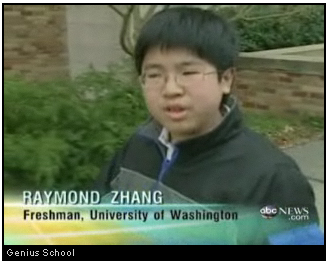
raymond_zhangThis past week, ABC’s Nightline did a news segment on Genius School – Inside an innovative class for some of the world’s most brilliant kids (video: 7 minutes. 40 seconds) and profiled Raymond Zheng, a fourteen year old freshman at the University of Washington. The news segment also profiled current middle school-aged students — mostly thirteen year old’s — in a one-year program at the “Transition School,” officially known as the The Halbert and Nancy Robinson Center for Young Scholars, which Raymond attended prior to entering college.

Young, precocious kids such as Raymond are fascinating, and sometimes I wish I were so bright. But why focus on Raymond? Maybe his parents were the only ones to agree to have their child profiled. But when Raymond says during his interview that “I find that I like math and science quite a bit,” I wonder if Nightline is reinforcing the stereotypical Asian American “model minority.” Raymond even performed piano recitals in kindergarten, currently has a 4.0 grade point average, and his favorite past-time is, yes, doing homework.

As an Asian American kid growing up in a white suburb in Western Massachusetts, I kind of identified with the model minority myth. Since moving to California, I understand much better the consequences and unfair expectations this myth imposes on Asian Americans.

The profile of the “Transition School” interviews students of this select sixteen student program that seemed like a fairly well balanced of students interested in a variety of topics beyond math and science, but I wonder also how kids like Raymond adjust socially to a college environment, given their age; do most of these kids adjust well? I have to imagine that there some social and peer issues that these Doogie Houser’s have to come to grips with.

Image Source: ABC News / Nightline.

What next?

  • Subscribe to this feed
  • Leave a comment

7 Comments to “ABC’s Nightline Profiles Raymond Zheng, “Brilliant Kid””

  • I’m calling it now: He’s going to be a meth addict by 2015.

  • I don’t think ABC sought to reinforce the model minority stereotype, even if that’s what it comes across as. If they interviewed a bunch of kids, and one of them is Asian, well, that’s fine. And good for Raymond. I don’t remember what I was doing at age 14 but I was certainly not taking college courses!

  • This is a fascinating story, obviously because they did a news story about it, as well as you guys covered it here on 8asians…But also I think the video is excellent because they allow him to talk a lot on it quite a bit as opposed to just voice overs from news anchors. Yes they ask certain questions but they didn’t seem to be filled with any overt agenda. I do think they brought up the normal social concern aspects like detachment from peers or different “not so normal” environments for 14 year olds. I think Raymond makes anyone proud. He’s the kind of kid who makes me feel better about this world. Hopefully with good direction from his parents and friends, he will grow up to kick john chiang out of the controller seat. OH YES I DID!

    thanks for the post!

  • I am a graduate of the advanced placement program in Seattle that a lot of these kids come from; a couple of my friends did the Transition School. They’ve turned out to be pretty normal—still weird little dorks as expected, but normal in a Seattle-sense.

  • i am also a product of one of these advanced placement programs, and i think that focusing on an asian kid is nice. when i was 14 and in college, good morning american did a segment on the group of kids that i was in college with. most of us were kids of color, but of course good morning america only showed the solo interview with the one blond kid in the program. the rest of us were background.

    as for adjusting to college life, it varied by kid. back when i went through it, there were only a few of us running around a large college campus and nobody even knew that kids could go to college early. some of the students would get mad because they would get asked if they were lost or were looking for a parent. and then dougie houser came out, and all of a sudden that’s what we were called by everybody every day.

    some of the boys felt that being in college at such a young age hampered their social life, especially with girls. i mean, most college girls aren’t interested in 14 year old boys. and some of the girls were creeped out by the college aged guys that would ask them out. as the program got bigger and there were more and more kids, it became easier for them since they could all hang out with each other.

  • i’d also like to add that Yan will most likely be a meth addict by 2011. just kidding. :)

  • If the kid is ready and can handle the courseload, I think it’s actually better for them socially if they go straight to college. Yeah, he’s not the typical college student, but then no one really is–there’s far more diversity in terms of interests, culture, lifestyle, and overall motivation and drive at the typical college than the typical high school. Frankly, a kid like Raymond would get picked on or ostracized at the average American high school, while in college he’s more likely to be able to just do his own thing. I remember at my college, there was a handful of obviously younger students–maybe geniuses–but no one bothered them despite their age, intelligence, geeky clothing or poor social skills. Finally, he’s not going to be bored in college, whereas boredom in high school is the bane even for the least gifted/motivated student.

    Now on the model minority issue, what would you have said if they interviewed a white or black kid? I think it’s good that they interviewed an Asian kid–I mean, how often does an Asian get to open his mouth on national TV or in a movie without some chopsocky/foreign-sounding gibberish coming out? The most famous Asian actors on TV play foreigners, for God’s sake–Daniel Dae Kim and Masi Oka. And I wouldn’t be too sensitive about the Asian achiever stereotype–think about all the Asians you know–don’t they fit into that? There are powerful cultural reasons why many Asians do well, and it doesn’t just have to do with the fact that many Asians came here as professionals. Ask yourself, why are there a lot of engineers and scientists from Asia coming over here? Because these cultural factors are present even in the home countries. It is wrong, of course, when they use the stereotypes to indirectly put down other minorities because other groups had arguable worse experiences here. Yet it doesn’t mean that we shouldn’t be proud of our achievements collectively, just like every group.

Post a Comment

Email addresses are never displayed, but they are required to confirm your comments.

*Required
*Required (Never published)