
8 Asians


skitched-20090523-192159Oh my god, if I hear or see the word “banana” used as a descriptor for Asians who have assimilated into “North American” culture, I am going to cry (like, actually.) And I don’t care if Asians are using the term themselves as a self-descriptor. It doesn’t make it any better; in fact, it’s probably worse. East Asians in North America are not off-shoots and variations of the norm (read: white). So when I came across Banana: A Chinese American Experience, an installation project about Chinese Americans by Claudia Chow, I was peeved and disappointed.

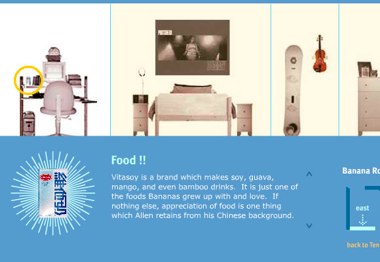
The project examined “the influences which shape the lives of Chinese American youths in the U.S.” through an installation at the Lower East Side Tenement Museum that reconstructed “the apartment of the fictional Lee family, second-generation Chinese Americans presently living in New York City.” The project is also online as an interactive web installation.

By clicking on various objects (including a violin and the Sanrio character Badtz-Maru) inside the interactive apartment, we are “taught” about various supposed Chinese American values and traditions. These values include the importance of family, food and education. We also learn about the difficulties of assimilating into the “American Way of Life” while maintaining Chinese traditions.

Claudia Chow’s artistic statements says that this installation is a snapshot of “one single Chinese American family.” I think what is really going on here is that she tried not to generalize by tossing in a half-hearted disclaimer, in hopes that it will be enough to cover her ass. Too bad it doesn’t work that way. Too bad when artists of colour center their work around issues of race, we are forced to take into account issues of representation and expectations that other artists (by which I mean white artists) don’t have to worry their little hearts over. Banana isn’t just about the Lee family; anyone who looks like a possible “Lee” is implicated in this installation.

Also, who is the intended audience? What is Claudia Chow trying to accomplish? It sure doesn’t seem like the project was created with Chinese Americans in mind. For one, the entire web installation is in English. Second, surely Chinese Americans have no need for such a project when they are the subjects of their own lives. Banana seems more like a “multicultural” anthropological study, intended to aid non-Chinese Americans in better understanding “the Chinese American experience.” Damn, nothing more disappointing and infuriating when people of colour in positions of authority tokenize and pigeon-hole themselves, which in turn, does the same for everyone else who looks like them.

And come on, these types of voyeuristic cultural glimpses are so tired. Doesn’t, like, everyone have a Chinese friend nowadays (and a black friendand a gay friend, too)? No one needs a project like this to know how Chinese American families operate! They are everywhere! If you are worthy enough and your Chinese friend is kind enough, maybe you will be invited over for a first-hand taste of Chinese American struggles in the land of the free.

What next?

  • Subscribe to this feed
  • Leave a comment

Other posts you may be interested in:


  • Ruby
    I think you're being a little harsh on Claudia Chow's project.
    In fact, I don't think her disclaimer is "half-hearted" at all.

    "It sure doesn’t seem like the project was created with Chinese Americans in mind. For one, the entire web installation is in English."
    Right...because obviously all Chinese Americans only speak/read Chinese and don't use English as their primary language [sarcasm]

    "Doesn’t, like, everyone have a Chinese friend nowadays (and a black friend… and a gay friend, too)? No one needs a project like this to know how Chinese American families operate! They are everywhere!"
    You assume way too much. Chinese people (heck Asian people) are not as ubiquitous in the Americas as you suggest. My guess is that you have never traveled in the South/Midwest areas of the US.

    If this piece was meant to be satirical, then good job.
    If not, then calm the heck down.
  • daniel
    to me, it's not infuriating as much as it is boring and safe. every description in the exhibit (the virtual one, at least) sounds so generic and bland. the back story is a start, but again... it's just so generic and sorely lacking in details that make the story believable.

    this exhibition was done way back in 2001 though... a little late to be critiquing it now, imo.
  • mariposa144
    This exhibit is so stereotypical and shallow that I initially thought that it had to be sarcastic. Asian American artists don't get many opportunities to present something like this to the American public so I'd hope that if someone did that they'd go a little deeper than this. What about showing Asian Americans doing something that isn't strictly model minority-there are plenty of Asians living in apartments in New York who are gay, political activists, gang members, environmentalists, etc. (I'm sure anyone who reads this blog knows this) And what is the point of this exhibit? There's no information on there you can't get from wikipedia, the presentation isn't innovative, funny, insightful, etc. I can't help but cringe when I think of the stereotypes this reinforces to non-Asians who visit the site.
  • Mitsuru
    i totally appreciate museums for their educational value.

    if it wasn't for them, i wouldn't know what ostrich shit looks like up close, how many possibilities there are for the field of taxidermy, and (being an outsider without Chinese American friends) how these fascinating people live in their day to day lives.

    i think Chinese Americans, like you Teresa, should be honoured to be placed among the most interesting species man-kind has been able to capture and put glass around.
  • The idea I got was that the online installation was to be made for elementary, junior high and high school students. I got that from clicking on the "schoolhouse" tab, and then clicking on the "books section."

    If that's the case Teresa, I'm going to agree with Ruby on this one. Banana isn't geared for us, it's geared for non-Asians kids and teenagers.

    nothing more disappointing and infuriating when people of colour in positions of authority tokenize and pigeon-hole themselves, which in turn, does the same for everyone else who looks like them


    Very well; if you were Claudia Chow and were you create an installation depicting Chinese Westernized life in a web installation, what would you do differently?
  • JC
    I think Teresa's a little bit harsh too. I personally use the word banana with my friends and I don't consider it derogatory. I've never heard any white people use it to - it's always a label used among Asians themselves. A banana is basically someone who was raised white - meaning their understanding of the world and even themselves were adopted from whites. They don't know anything about Asian culture other than the stereotypes, or they are exposed to it but intentionally avoid it all their lives. They're also ignorant of Asian culture, pop or otherwise, and tend to avoid Asians unless they're also bananas. It's only after they're old enough to really confront racism from whites will they even try to find their Asian side - and even when that happens sometimes they limit themselves to the accomplishment of other white-washed A-A's. They use the term FOB liberally and with disdain. I don't mean to sound like a hater, but that's just how I see them. I used to love to educate my "banana" friends about Asian pop culture, and show them that there are actually attractive Asians out there.

    I think for these type of "bananas", a display like this maybe necessary. They are culturally and spiritually white (their "white persona" tend to be geeks or hipsters, for some reason) and a little bit of understanding of Asian values is useful, especially when they're at that "Looking for my Asian roots" stage. Teresa, I think since you've spend half your life in Taiwan, you probably speak mandarin Chinese and one other Chinese dialect, know what to eat in the Shiling Night Market, and know who the heck "Little S" is. That means you're not a banana. So perhaps you're looking at this from my point of view, which is a "Half-Banana", meaning split in the middle in term of being White and Asian. This project would be a little offensive to us, but from a pure-bred banana PoV, it may be useful.
  • As a former editor of an Asian North American mag called Banana, I don't find the term offensive. Sure, I came across people who found it offensive, but the content of its pages made up for it because we were able to play around with trying to understand ourselves caught between two cultures. And same with Claudia Chow's art installation.

    I agree with JC; for a person like me, who has never been to Asia as an adult has only an idea of Asian culture is as opposed to someone like the author who has spent half her life in Taiwan KNOWS.

    The metaphor really only means something to Asians and I actually find the term Jooksings more offensive, but that's a different story altogether.
  • BigBrotherSpeaks
    Banana is extremely offensive, similar to Uncle Tom, coconut, or Oreo. It is entirely inappropriate in the context of the current exhibit and unfortunately, reinforces a negative stereotype to an audience that really doesn't need any more of that kind of disinformation. This type of exhibit would be much better off as part of an intro Asian American course where it could be balanced better and provide greater context as well as opportunities for further dissemination and discourse. To throw about the term banana without proper context is irresponsible and intellectually lazy.
  • @Ruby: I just assumed that 8asians readers would understand that I obviously do not assume that Chinese Americans do not speak English. I feel like my overall critique of the installation should speak to that. I was just pointing out how the installation is not as accessible as it could be, if Claudia Chow indeed had Chinese Americans in mind.

    @Daniel: It is an old installation, but no one has commented on it on this blog. More importantly, though, the installation is still available online to anyone who has access to the internet. Plus, the issues raised are still pertinent.

    @Ernie: I wouldn't have done anything differently because I wouldn't have created a project like this to begin with. If Claudia Chow's intention was to "educate" and "enlighten" non-Asian, elementary to high school aged students (which I would actually disagree with), I think an interactive website introducing radical Asian history and Asian revolutionaries would be much more beneficial. There are many similar depictions of East Asian family life in movies, books and TV.

    @JC: While I disagree with pretty much everything you've shared in your comment, I am willing to engage in discussion as long as you are critiquing what I have written. Once you start to make assumptions about my personal life, telling me what I am/am not, then I choose to step back and not have the dialogue with you.
  • Hi Teresa,
    Thanks for the insightful post. I really enjoyed reading this entry. While I'll admit that I've jokingly thrown around the term "banana" and "twinkie" before, I agree that it reduces us to a variation of the norm: white, the default race. I don't think that Asians can be neatly categorized into the two categories of "fob" and "whitewashed." I personally have a hard time identifying with either term. Technically, I'd be in the fob category, as I've lived in America for only four years, but I can barely relate with my "fellow fobs" (that is, the Asians that Asian-Americans lump together) at all...my first language is English, I grew up watching American cartoons, I listen to Western music, my humor is American, etc, I do all those things associated with being a "banana." But who gets to make those qualifiers? And why do I find myself resisting either category, yet desiring of some category - some populace - to belong in? I feel slightly rejected by both groups, but at the same time, I don't want them to like me based on my "Asian credentials." I want people to like me because of who I am as a person.

    Real people are full of contradictions, but I think the problem with depending on categories to relate with others is that they don't allow for them.. All "fobs" like karaoke, can sing Jay Chou, dye their hair, do Asian poses, have accents, only hang out with each other, etc. All "bananas" are afraid of hanging out with other Asians, and only date white people. Oh no, alert the presses when a fob hates taking pictures, or when her best friend isn't Asian!

    Plus, they provide a supposed easy route into forming relationships. I can't count the number of times I've been introduces to somebody just because that person is also Asian, or he/she grew up in Taiwan, etc. And sure, it gives us something to talk about, but those things don't guarantee a deeper connection.

    Back in the day, I used those terms in good fun, but as I grew older, I realized that by doing so, I was normalizing the use of stereotypes. The fact that those stereotypes are more pervasive than I imagined really hit me when my white roommate started identifying certain personality traits (cutesy, defensive, etc) as a distinctive "Asian things."
blog comments powered by Disqus