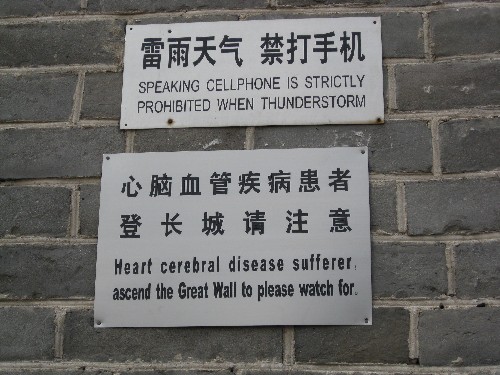
Growing up, I would visit Hong Kong and/or Taiwan every year to visit family and see my birthplace. At first, during these visits, I would try to read signs or menus using whatever Chinese characters I could muster. However, as I progressed through the American school system, it became much easier and comfortable to read the English translations. Even in my early teens, it was easy to tell that some of these translations had critical grammatical, diction, and spelling errors. In most cases, one could easily decipher what the phrase truly meant, but in others… You always figured someone would start a hefty business correcting such errors, or at the very least, be low-cost translators for small businesses. Guess not.
“Engrish” or “Chinglish”, as a phenomenon, has permeated through so much of Asian culture that some people are considering it to be beyond a parody of grammar and instead believe that it is an integral part of modern Asian culture. However, even if one does consider “Engrish” to be the – for the lack of a better word – “progression” of English in certain parts of the world; many social problems, especially in our increasingly border-less world, become more and more pertinent as “Engrish” becomes more socially appropriate and accessible. “Engrish” doesn’t necessarily promote a good image on behalf of Asians; it’s hard to be proud of something like this because it ultimately reflects the ignorance, and even a bit of stupidity, on those who create the signs. Not to mention, those who do need English to navigate themselves through Asia could easily have trouble understanding “Engrish” signs.
It also promotes the use of “Engrish” to those who are not native English speakers. Many times, we hear stories of or see “Fobs”, the immigrants who are “Fresh off the Boat” that subsequently do not have proper mastery of colloquial English. From what I remember, elementary school teachers used stop signs or stop lights to promote the learning of spelling and language. The same can be said of learning a second language. If all around you, there are signs using English that is grammatically incorrect, and you assume it is correct, why should you not think that its a proper usage of the English language?
It’s not that the translation isn’t hard enough: even the simplest things like “Yes” or “No” to certain questions could be confusing due to cultural upbringings and grammar. Ben clarifies for us:
The question of: “Tomorrow we don’t have class?” can be qualified by multiple answers:
1) Yes. – Yes we have class.
2) Yes. – Yes, we don’t have class.
3) No. – No, we have class.
4) No. – No, we don’t have class.1 and 4 are essentially the same as are 2 and 3. But it depends on how you phrase the question and how the answer is phrased.. Also, negations in Chinese are tied to specifics. You rarely say bu (不), and instead you say buyao (不要), or meiyou(沒有). In any case, this guy is… simplifying it too much.
He’s right. The author’s oversimplifying the concept, but there have been instances, with my aunts, cousins, and even my mother, where I have had to clarify because they answer simply with a word. So a “Yes” to the question like “I can’t stay out past midnight?” (because sometimes even 18 year old college students have curfew when they’re back home) makes me question “‘Yes, I can’ or ‘Yes, I can’t'?” Ultimately the best solution is to ask a better question: “Can I stay out past midnight tonight” which leads to “Yes” or “No” with no confusion.
Still, this phenomenon, and the ramifications it carries, only further accentuates the difficulties of crossing cultural borders splitting the East and the West. Widespread change and corrections throughout Asia is highly unlikely, and “Engrish” is without a doubt going to stay, cultural impacts or not.
NOTE: 8Asians.com is a community, and we thank you for being a part of it. While we welcome and appreciate differences in opinion, if you're rude or you're promoting spam, we have a right to edit or delete your comment. Read our comment policy for more information.
If you see a comment that violates the 8Asians.com comment policy, you may flag the comment by mousing over the comment and clicking "FLAG."
I actually find the post slightly fascinating from a linguistic standpoint and how culture directly impacts how we interpret things.
My dad was reading a local newspaper in Chinese and got stuck on this word - not because he couldn't read it, but couldn't understand its meaning in the context of the sentence. It turns out, it said, "Richmond Hill" - which is a city North of Toronto - but they had chosen to use Chinese characters to represent the city symbolically rather than phonetically. Likewise, ask a person in China if they know who George Bush is, and they wouldn't ... they know Jiaoshi Bushe (I think that's how they know him as, Ben?) And China isn't the only place where these kinds of bastardizations of the English language are seen - moreover, it's an extensive exercise in international communications.
Really, it goes both ways. I think we as English native speakers get spoiled because we among over half of the world's population can be understood - that not enough credit is given when someone makes the effort in being understood. I get my Mandarin corrected all the time - and when someone apologizes for not being able to speak English well, I in turn say, "It's ok, I can't speak <insert language> either. Just try your best." 90% of the time it's THEM that makes the effort to speak English and not the other way around.
I actually find the post slightly fascinating from a linguistic standpoint and how culture directly impacts how we interpret things.
My dad was reading a local newspaper in Chinese and got stuck on this word - not because he couldn't read it, but couldn't understand its meaning in the context of the sentence. It turns out, it said, "Richmond Hill" - which is a city North of Toronto - but they had chosen to use Chinese characters to represent the city symbolically rather than phonetically. Likewise, ask a person in China if they know who George Bush is, and they wouldn't ... they know Jiaoshi Bushe (I think that's how they know him as, Ben?) And China isn't the only place where these kinds of bastardizations of the English language are seen - moreover, it's an extensive exercise in international communications.
Really, it goes both ways. I think we as English native speakers get spoiled because we among over half of the world's population can be understood - that not enough credit is given when someone makes the effort in being understood. I get my Mandarin corrected all the time - and when someone apologizes for not being able to speak English well, I in turn say, "It's ok, I can't speak <insert language> either. Just try your best." 90% of the time it's THEM that makes the effort to speak English and not the other way around.
Errr. Either I'm really obtuse (very VERY possible) or you're extremely sensitive (in that there doesn't seem to be much feedback after yours, but I could eat my own words when more comments follow). Either way, I think its best if I clarified terms because I guess this post could be seen as offensive.
"Fobs", at least from where I'm from, doesn't hold a negative connotation. Although, I do know people who treat it the same way "gay" is treated; in that it could be offensive to 1st or 1.5 gen. immigrants... but they are a minority. Then again, my hometown is about 70% Asian and attracts many immigrants from Hong Kong and Taiwan sooo.. the usage could be skewed. Not that it's a proper defense of the usage of "Fob", but I was/am technically a fob considering that I immigrated from Taiwan right before elementary school started.
"Ignorance" and "stupidity" (okay, stupidity may be pushing it) are, imo, justified because the improper use of the English language could be seen as "ignorant" to those who treat English as their native tongue. I'm sure if I butchered, (and lets be honest the spelling and grammatical errors in some of these signs butcher the English language) a foreign language, many people who speak that language would be offended.
I don't see how "proper usage of the English language" is offensive. In the context, it's simply a replacement for "grammatically correct"... at least that was the intention. Although in hindsight, "grammatically correct" may have been better.
Any English teacher throughout grade school would probably agree with me when I say that there are right ways and wrong ways to use the English language... and there are very little, if any gray areas in between. We were graded on this stuff, so I think the im/proper use of it is pretty important.
That being said, if I do offend anyone, sincerest apologies. I am accessible through Facebook or e-mail for discussion and am more than willing to talk about such issues/controversies.
(I know I'd look really silly if there are grammatical errors in the post or this comment, and I'm pretty sure there are a few. Just bear with me on that.)
- Kevin
Feb 16: Adam WarRock and Kirby Krackle: West Cost Tour Dates!!!
Feb 17: (Los Angeles, CA) All My Sons
Feb 18: (Stanford, CA) Stanford’s 16th Listen to the Silence Conference
Feb 25: (Los Angeles, CA) Past Present I Future Imperatives: Queer Space Time
Mar 3: (New York, NY) Vong Pak’s ‘Electric Shaman’ Concert
Apr 30: (Sacramento, CA) California Asian Pacific Islander Policy Summit 2012: iAdvocate
[...] “Engrish/Chinglish”: Language Lost in Translation Speaking cellphone is strictly prohibited when thunderstorm. It makes sense! language:english language:chinese language:engrish [...]