
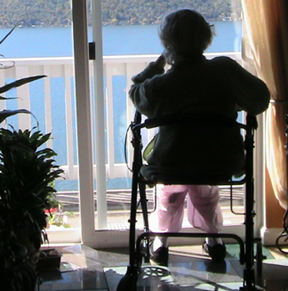
If you’re more Chinese (or Asian) than you are American, you know exactly what I mean when I say it’s expected the kids will take care of their parents when they are older. Confucius called it filial obligation, even the Chinese government passed it as law. As an immigrant to the U.S. myself, I always knew that some day I would have to take care of my parents. It was part of our normal discussion. My conversations with my mom would inevitably include something like:
Mom: Make sure you marry a Chinese girl, so when I’m old and come to live with you I’ll be able to talk to her.
Me: Uh, ok. What if she doesn’t speak any Chinese?
Mom: It doesn’t matter, we’ll understand each other, as long as she’s Chinese.
[Eventually I failed on both counts - my spouse is neither Chinese nor a girl]
If you know a bit about Chinese culture, you also know historically the youngest daughter was the one who stayed behind, didn’t get married and took care of the aging parents. I think in the back of her mind my younger sister always felt she had that role to play even though she got married and had kids, so she stuck by my dad’s side when he got sick with cancer. But it was always known that I would be the caretaker for my mom, when her cancer came back from remission.
The question of which child cares for the elderly parent was the recent topic of a NY Times article, which tackled the widely held belief in American culture that parents treat and love their kids equally (there’s obviously no such thing in Chinese culture). According to the Cornell University study (quoted by NY Times), American parents do really have a favorite child, even if they tell their kids otherwise. It’s their favorite child, who they typically want to be their caretaker in later life, even if their favorite isn’t the best suited (due to things like bankruptcy or drug abuse).
So I guess it should be no surprise to anyone, my younger sister was always my dad’s favorite, and I was always my mom’s. That much was obvious to anyone who knew our family. My parents didn’t hide it the way American families do. In another interesting aspect of the Cornell study, they found that the adult children in the study quite often incorrectly identified the favorite child in the family. Most often they’d say it was themselves, incorrectly. I guess that goes to show you, in American culture, there’s at least a facade of loving all the children equally. Being in America I think my parents at least attempted to do that, even if they didn’t succeed. Do your Asian parents play favorites? Is it obvious, or do they tell you all, they treat you all the same (I hesitate to use the word love as we all know Asians don’t use the word love and I love yous are for white people).
NOTE: 8Asians.com is a community, and we thank you for being a part of it. While we welcome and appreciate differences in opinion, if you're rude or you're promoting spam, we have a right to edit or delete your comment. Read our comment policy for more information.
If you see a comment that violates the 8Asians.com comment policy, you may flag the comment by mousing over the comment and clicking "FLAG."
wow natalie, sorry to hear that. ;( hope things change for the better.
I really think I got lucky in that case becuase I hear similar stories form other non-asians about their asians in-laws.
my inlaws are korea and I'm european/central american. I cannot speak korean and they cannot speak english, yet they LOVE me. my husband is the oldest and the only son, yet they treat me better than they do him. I got married at a young age, and they supported me 100% on everything I did. they provided a home for me and my husband when we married, bought me a car, paid for my college, and make me special vegan versions of their traditional foods. when me and my husband argue, they usually take my side. they always tell me how sweet I am, how pretty I am, and how good of a wife I am. they actually cried when I had a miscarrage.
I cannot call them by their name or "mr. & mrs.", it must be umma and appa. my mother in-law always touches my hair and says things like "my sweet daughter".
I can tell they ecpect that I'll be the one taking care of them when their older, and I'll love doing it, they are great in-laws for any race, lol.
wow natalie, sorry to hear that. ;( hope things change for the better.
I really think I got lucky in that case becuase I hear similar stories form other non-asians about their asians in-laws.
my inlaws are korea and I'm european/central american. I cannot speak korean and they cannot speak english, yet they LOVE me. my husband is the oldest and the only son, yet they treat me better than they do him. I got married at a young age, and they supported me 100% on everything I did. they provided a home for me and my husband when we married, bought me a car, paid for my college, and make me special vegan versions of their traditional foods. when me and my husband argue, they usually take my side. they always tell me how sweet I am, how pretty I am, and how good of a wife I am. they actually cried when I had a miscarrage.
I cannot call them by their name or "mr. & mrs.", it must be umma and appa. my mother in-law always touches my hair and says things like "my sweet daughter".
I can tell they ecpect that I'll be the one taking care of them when their older, and I'll love doing it, they are great in-laws for any race, lol.
My parents always treated us the same, so it was not obvious to us who they favored more. I did ask when I was younger, and they said they loved all 3 of us equally. I believed them then, but now that I am a parent, I know they were probably lying. And if I had to guess, I'd say I was my dad's favorite and my middle brother is my mom's favorite. But with extended family, I pretty much don't exist. My dad is the first son, and my middle brother is the first son as well, so he gets all the attention from them. (We are Taiwanese.)
Oof, I'm having a lot of awkwardness with my in laws at the moment re: cross cultural differences (they're HK Chinese and I'm white/English) and "weu00e2u0080u0099ll understand each other, as long as sheu00e2u0080u0099s Chinese." rings a little too true for comfort. That definitely seems to be the cavern between me and my mother in law, although she's trying her best to find common ground with me, and there's no negativity in particular, just... well. She gets along a lot better with her nephew's wife, who is Chinese born. I'm just left out on the edges of conversation, feeling awkward.
Having said that, my husband is the eldest and only son, and he's definitely the favorite out of the three siblings. Definitely definitely the favorite. They treat the three of them completely equally, and by most counts are a very modern and American family, eg: they don't intend on being taken care of when they're old(er). But you can still see a thin thread of traditional mindset running through the family for sure.
Oof, I'm having a lot of awkwardness with my in laws at the moment re: cross cultural differences (they're HK Chinese and I'm white/English) and "weu00e2u0080u0099ll understand each other, as long as sheu00e2u0080u0099s Chinese." rings a little too true for comfort. That definitely seems to be the cavern between me and my mother in law, although she's trying her best to find common ground with me, and there's no negativity in particular, just... well. She gets along a lot better with her nephew's wife, who is Chinese born. I'm just left out on the edges of conversation, feeling awkward.
Having said that, my husband is the eldest and only son, and he's definitely the favorite out of the three siblings. Definitely definitely the favorite. They treat the three of them completely equally, and by most counts are a very modern and American family, eg: they don't intend on being taken care of when they're old(er). But you can still see a thin thread of traditional mindset running through the family for sure.
The link was actually about Chinese in the Phillippines. For some reason all the links I found about Chinese culture and the youngest daughter, were about transplanted Chinese taking that bit of culture with them. Today, with fewer kids, it's more that the eldest son does it, but back in my parents day, when it wasn't unusual to have 8 kids (like both my parents who have 8 siblings), the youngest daughter didn't get married off and stayed around to take care of the parents.
That was a good link, even if it applies to Filipinos and not Chinese. The Wife is the youngest daughter in her family, and her parents lived with us for five years until The Wife couldn't take it anymore (see http://www.8asians.com/2008/11/01/wheres-my-furnit...).
The youngest daughter takes care of the aging parents? The link you provided was linked to a PDF report on Filipino culture...
Isn't the eldest son usually the head of a Chinese family and thus responsible for taking care of aging parents? Traditionally, daughters are to be married off?
The youngest daughter takes care of the aging parents? The link you provided was linked to a PDF report on Filipino culture...
Isn't the eldest son usually the head of a Chinese family and thus responsible for taking care of aging parents? Traditionally, daughters are to be married off?
My parents have never hidden their preference of my younger brother as the male child who will continue on the family name. He might be a teenager who spends all his time playing video games and doing nothing to help out around the house, but he can do no wrong.
Whereas I can work two part time jobs to support myself while studying for my Masters, I can pay my own way in everything since the age of sixteen (I have NEVER stopped working while studying), I can do heaps of chores around the house, and they can still kick me out of the house because I'm dating a white guy - which they did a few weeks ago.
And the ironic thing is, I'm probably more 'Asian' than my brother - I believe in the whole filial obligation concept. I'd be caring for my parents as they get older, but my brother is the type to send them to a nursing home. They're indulging the wrong child!
My parents have never hidden their preference of my younger brother as the male child who will continue on the family name. He might be a teenager who spends all his time playing video games and doing nothing to help out around the house, but he can do no wrong.
Whereas I can work two part time jobs to support myself while studying for my Masters, I can pay my own way in everything since the age of sixteen (I have NEVER stopped working while studying), I can do heaps of chores around the house, and they can still kick me out of the house because I'm dating a white guy - which they did a few weeks ago.
And the ironic thing is, I'm probably more 'Asian' than my brother - I believe in the whole filial obligation concept. I'd be caring for my parents as they get older, but my brother is the type to send them to a nursing home. They're indulging the wrong child!
It always bothered me and still bothers me to see how some Asian parents have some obvious favoritism toward some of their kids, especially when the favorite clearly has issues while a nonfavorite clearly has tremendous potential that is not being nurtured. My parents did a pretty good job of providing us with equally opportunity, even if they probably did have a favorite. My kids occasionally needle me and ask which of them is my favorite or say that I like one kid better than the other two. I usually say with a grin that I hate them all equally, and I find that quickly ends that particular conversation!
Feb 10: (Los Angeles, CA) CAUSE: Women in Power Annual Luncheon
Feb 15: (Seattle, WA) Pork Filled Players Enter The Year of the Dragon Spam*O*Rama
Feb 16: Adam WarRock and Kirby Krackle: West Cost Tour Dates!!!
Feb 17: (Los Angeles, CA) All My Sons
Feb 18: (Stanford, CA) Stanford’s 16th Listen to the Silence Conference
Feb 25: (Los Angeles, CA) Past Present I Future Imperatives: Queer Space Time
[...] so highly of that idea, to put it mildly. Often a multi-generational household happens because of the need to care for elderly parents. Indeed, the study points to data that says that older people living with others are generally [...]
[...] so highly of that idea, to put it mildly. Often a multi-generational household happens because of the need to care for elderly parents. Indeed, the study points to data that says that older people living with others are generally [...]