
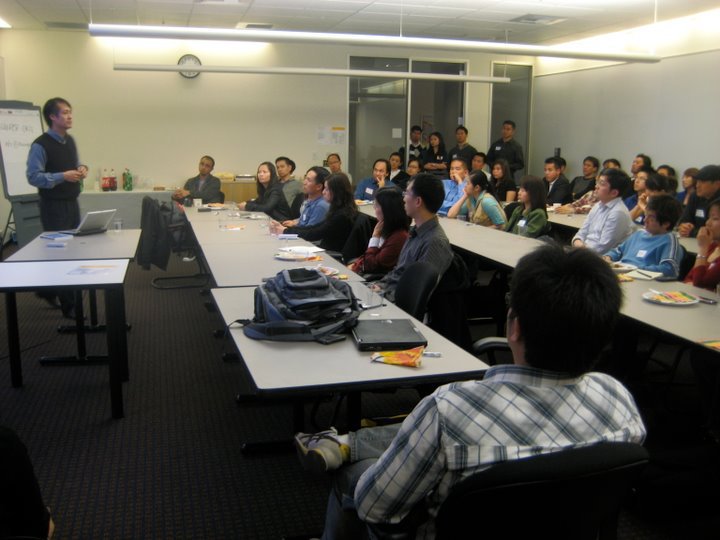
 About a month or so ago, I went to a networking event titled, “Opportunities in China” organized by the National Association of Asian American Professionals – San Francisco Bay Area Chapter (NAAAP-SF).
The guest speaker was Larry Wang, founder and CEO of Wang & Li Asia Resources, a recruiting firm. I had first heard of Wang & Li back in the mid-1990s when contemplating the possibly of moving to Asia instead of going to business school. They made a niche for themselves by focusing on recruiting American – usually Asian American – talent for opportunities in Asia. In retrospect, this was a no brainer idea given the economic growth of China back then. They must be doing something right, as they were selected as “China’s Recruitment Firm of the Year” in 2008.
I was eager to finally meet Larry and hear his story about career opportunities in China. His presentation was titled, “The Return Of China’s Hiring Market – Pursuing Career Opportunities In The Mainland Today” (.pdf) and I wanted to hear the real deal about finding a job in China, over all the press hype. Larry confirmed the realities of the job hunt: it was easier said than done. Back in December of 2008, I had met up with my friend who has a start-up in Beijing, and he said that there were a lot of unemployed Westerners trying to learn Chinese while looking for jobs. But the opportunities were limited, given the number of people seeking employment, unless you were teaching English.
The reality of finding a job in China is that it’s certainly not as easy as it was ten or twenty years ago, when you could be confident in finding an interesting opportunity just by moving overseas. After graduating from business school in 1999, I turned down a few job offers in Austin and the East Coast, and instead, moved to Silicon Valley without a job, like plenty of other MBA’s. During the dot-com boom years in Silicon Valley, it was very easy to get interviews and find a job. I did find an position at a real large software company that generated huge profit margins – which was the best decision I ever made, as most of the dot-coms where I interviewed subsequently went out of business).
Those insane crazy dot-com days are long gone here in the States, and the same might be said of China in terms of boundless easy job opportunities. Nowadays, companies in China want to make sure that you are committed to work in China beyond a year or two, unlike carpetbaggers who are looking just to ride out the recession in the United States. Larry said that there was a pause in late 2008 and 2009 in China, but after the government’s stimulus program, the economy picked back up. 2010 is looking good, which is certainly better than in the U.S. where unemployment nationally is still at around 9.6% and a modern record of 12.6% in my state of California.
According to Larry, the main challenge is that despite the tremendous growth in China, the level of competition with local talent has been increasing. More importantly, many mainland Chinese who went to study and work overseas in the United States have increasingly returned back to China, often labeled as “sea turtles” – Chinese slowly making their way back to China with better Mandarin language skills than Americans, especially your average American Born Chinese (ABC’s).
Less and less, American companies with a presence in China are looking for Americans to relocate to China and pay them “expat” (expatriate) salaries. Now, American companies are increasingly filling their Chinese offices from within the country, though perhaps only the General Manager or other high level executive positions would be hired from U.S. headquarters with an an expat package and a U.S. level salary.
That’s not to say all the best opportunities in China are with American companies seeking to expand into Asia. In fact, there are increasingly more medium-to-large Chinese companies seeking talent to help expand overseas, including companies you may have heard of already like BYD and Haier. Finding such opportunities from the United States can be challenging, but it was a process that was a lot harder before the Internet. Larry suggested to start with your own personal and professional network to do your research on opportunities in China, — and of course, to consider Wang & Li.
The big question is, how much Chinese you need to know when looking for a job in China. The easy and truthful answer from Larry was, “the more, the better.” Personally, my Chinese is fairly basic, and a Taiwanese college friend once told me I spoke like an 1st grader! Though I’m pretty proud of myself that I’ve known enough to get by when visiting China and was able to make some conversation with a taxi driver in Taiwan. While I am sure my Mandarin would improve dramatically if I lived in Taiwan or China, my reading skills are pretty bad. I can’t really read a menu at a Chinese restaurant.
So what do ABCs and Americans bring to China? Larry focused on the “soft skills.” The Chinese educational system (and Asian educational systems in general) are more “rote” and less focused on “creativity.” What Americans can offer, besides whatever technical or business skills, is knowledge in leadership, team work, professionalism and definitely a global outlook. Additionally, skills in sales or working in a professional services background are highly sought after. Chinese companies have often competed on price alone, and do not understand solution sales.
Salary-wise, you may be lucky to find the right opportunity for $60,000 a year. $60k may not sound like a lot, but as Larry had pointed out, if you are an American working overseas, your first $91,400 is exempt from U.S. taxes (though you do still have to pay local taxes).
So Larry’s next question was, why would you want to work in China? The main reason is the opportunity to do more, faster, i.e. accelerate your career path faster at a higher level. I saw this with my colleagues during the dot com period with its “Internet time,” where everything moved faster. The same thing is going on in China now, and my friends in Beijing and Shanghai definitely agree. “Chinese time” moves fast: things are changing so quickly there that Larry said that he often can’t imagine returning to the U.S. since everything seems to move so slowly here.
After attending the presentation, I pinged my friend Tom, who is currently working in Hong Kong and travels to Beijing periodically for work. His thoughts on Larry’s points were that it is still not hard for an American to find a job in China, even though the jobs may not be high paying or are different from those offered 16 years ago. The jobs today are more in the service industry or in manufacturing. Chinese companies still have a long way to go and foreigners can still help a lot with their global perspective. He suggested that I check out the blog “China according to Brad,” someone he knew well.
Another friend in Shanghai had other thoughts as well. Even though the economy is raging in China, unemployment is still high, which means companies there will still hire a local over a foreigner. (In the past decade, the government has expanded college enrollment from about 500k college graduates to 5 million). Even if a local Chinese company offers you a job, the salary will not compare to what you make in the US, though it may be substantially higher than the locals make if they need your experience. Companies will often hire foreigners with specific experience they value, learn what you know and then get rid of you. He also said that China is a much better place to start your own business than it is to work for somebody else,
“I have a competitive advantage over most locals with my 11+ years of biotech business development experience [in the United States]. I have also hired a Chinese analyst, so language is not a problem for me. Starting your own business is relatively easy here, but you have to deposit enough capital to run the company in your account, I think $50K-$100K. My business partner is the owner of the company and he has a work permit. I have a business visa, which is fairly easy to get.”
So what is the actual logistic of finding a job in China? The reality is, there is nothing better than actually being there. From the United States, you can research to find opportunities in China and make initial contact, then make a trip there to meet and interview with companies. You can also get transferred by your existing company in the U.S., which is even better. The best one can do is obtain a tourist visa, or if you happen to travel for work to China, a multiple entry visa. Although I haven’t really looked, I’d be really interested to read a blog about someone moving to China and trying to find a job there.
In the meantime, if you want to learn more, I suggest you check out the resources at Wang & Li, especially the videos.
- Excited
- Fascinated
- Amused
- Disgusted
- Sad
- Angry