
8 Asians

  • About us
  • Write for 8Asians
  • Advertise
  • Contact
  • Suggest |
  • Podcast
  • Events
  • GASP!
  • POP 88
Manny Pacquiao, Filipino Homophobia And MasculinityManny Pacquiao, Filipino Homophobia And Masculinity
The Mindy Project Makes Mindy Kaling Even More HilariousThe Mindy Project Makes Mindy Kaling Even More Hilarious
8Questions with Jessi Malay, Hapa Artist8Questions with Jessi Malay, Hapa Artist
The Carrie Diaries Trailer Proves That Minorities Do Exist In New YorkThe Carrie Diaries Trailer Proves That Minorities Do Exist In New York

The New Visibility of Asian Athletes

By Guest Writer | Friday, July 8, 2011 | 13 Comments

sports The New Visibility of Asian Athletes
By Sheldon

The year was 2002 and the Houston Rockets had just announced they would select Yao Ming as the number one overall pick of the NBA draft. I was ecstatic. At the time, I was a middle school student and remember trying to find every opportunity to follow Yao Ming’s career.

My family didn’t have cable television back then, so instead I tried to stream the games live onto my computer– even if it meant downloading virus and spyware filled programs. When I finally found a live broadcast of the game, I usually ended up staring at a pixelated screen and the words “buffering” for hours.


Yao Ming led a new generation of Asian athletes into mainstream media. As the first Asian face I remember consistently seeing on TV, I envied him for his success as a prominent minority in a field with few Asians.

For me, a young teenager who grew up in the Caucasian-homogenized Midwest, seeing other Asians was rare. I had few people who shared a similar background that I looked up to so I naturally gravitated towards the NBA superstar.

However, truth be told, Yao Ming and I shared few similarities. He was 7’6″, I was 6’0″. He barely spoke English, and I barely spoke Chinese. His cultural background was mostly Chinese, while I was American – the definition of a 香蕉 (banana) as the Chinese would call me. Either way, I had few role models – I took what I could get.

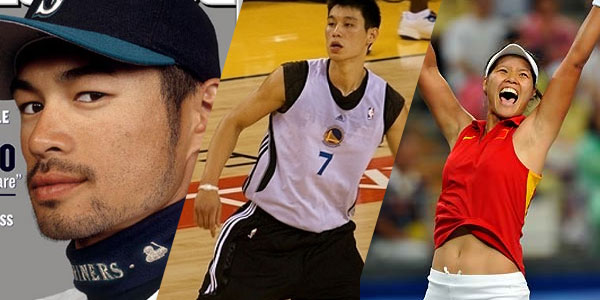
During this time, other Asian athletes across virtually every sport began to attract international attention. In baseball, the Seattle Mariners signed Ichiro Suzuki of Japan in 2001. He recorded an astonishing 242 hits in his rookie season – more than any other MLB player since the 1930s.
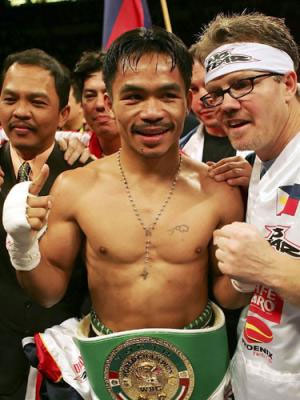
manny The New Visibility of Asian AthletesWhile Ichiro led Asian baseball players into the spotlight, a man from the Philippines was starting his career in professional boxing. In 2001, Manny Pacquiao made his first major appearance in the United States at the Las Vegas MGM Grand Garden Arena winning the International Boxing Federation Super Bantamweight World Title. Ten years later, Pacquiao would be named the number one pound for pound boxer in the world by almost every major news outlet.

Internationally, the 2002 FIFA World Cup was underway and Asian teams began to soar up the rankings. Park Ji-Sung, a South Korean soccer player quickly made his name known by leading the Republic of Korea football team to the final four of the World Cup tournament. Soon after, the most successful English club football team, Manchester United, signed the South Korean star to play center midfielder where he still is today.

In the same year, K.J. Choi of South Korea won his first PGA Tour at the 2002 Compaq Classic of New Orleans. He has since established himself as Asia’s most successful golfer, spending 40 weeks in the top 10 of world rankings and recently winning the very prestigious 2011 Players Championship.
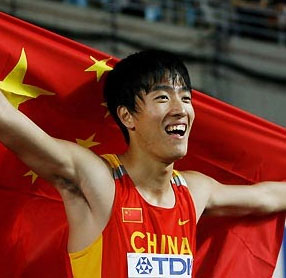
liu xiang The New Visibility of Asian AthletesSince the initial breakout of Asian athletes in 2001 and 2002, many more Asian athletes have risen to elite status. Liu Xiang’s 110 meter dash world record and gold medal performance at the 2004 Athens Olympics silenced critics who questioned whether Asians could compete among traditionally underrepresented sports like track and field.

Other stars such as Yi Jianlian, Daisuke Matsuzaka, and Y.E. Yang kept the momentum going, meanwhile at the Beijing 2008 Summer Olympics, China led the gold medal count. And yet, despite all these Asian successes, I still had not found a role model who grew up in America like me – until 2010.

Jeremy Lin was born in 1988, only two years before me. His father, a Chinese immigrant to America quickly fell in love with basketball and often brought Lin to the local Palo Alto, Calif., YMCA to shoot hoops. Similar to Lin, I too grew up going to the local YMCA almost every day to play basketball.

To me, Lin felt like a normal kid who could have been my friend growing up. Coupling great athleticism and work ethic, in the 2005-2006 season he led his high school basketball team, Mater Dei, to a 32-1 record and California State Division II title. Even though, Dana O’Neil of ESPN said, “Lin was the runaway choice for player of the year by virtually every California publication,” no Division I schools expressed serious interest in him – only Harvard and Brown guaranteed him a spot on their basketball team.

The 6’4″ guard proved his skeptics wrong by leading Harvard to their best season in school history, finishing his senior year with stellar statistics, including: 16.4 points per game, 4.4 assists per game, and 2.4 steals per game. However, once again Lin was overlooked, going undrafted in 2010. The Dallas Mavericks offered him a spot on their summer league, where by pure luck the starter was injured, giving him an opportunity to prove himself again to his critics. Lin showed that he could go head to head against the number one pick of the 2010 draft, John Wall, and excel both offensively and defensively.
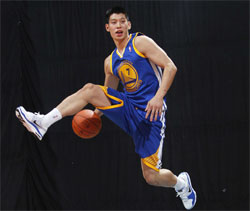
jeremy The New Visibility of Asian AthletesAfter watching Lin’s performance, his hometown team, The Golden State Warriors quickly signed him. Unsurprisingly, even as a Warrior, people still had their doubts and Lin’s minutes were limited. Only until the end of the season did people start believing in him, most notably Warriors head coach Keith Smart and former Warriors head coach Eric Musselman who said in an interview, “Unequivocally, Jeremy Lin is an NBA basketball player.” I had finally found a role model that grew up facing the same discrimination as I did, being a former athlete in volleyball, basketball, and swimming.

To finally solidify these trends, in the same year, Ed Wang, a 6’5″, 300 pound offensive tackle was drafted out of Virginia Tech by the Buffalo Bills to play in the NFL. Meanwhile, in the past few months, Li Na has also led a rise of tennis stars from Asia. This year, she finished as runner-up in the 2011 Australian Open and recently won the 2011 French Open, escalating her ranking to number three overall among female tennis players.

As I witness more and more Asian exposure in athletics, I wonder to myself: will this trend continue as more and more hidden talent is discovered among the colossal populations of India and China?

I often argue with friends who tell me the reason China won the most medals in the Beijing Olympics is because of their sheer population size. However, few realize that even though China does have a large population, only a fraction of them actually have the leisure time to participate in athletics with proper training and nutrition.

Many of these booming Asian countries lack structured athletic programs that can seek out talent at a young age from across the entire population. As a comparison, a huge number of American youth begin playing soccer at a young age. At least for me, the majority of my friends had the opportunity to play in club teams which allowed for the discovery of talented players.

Due to the sheer population size of many Asian countries, I believe this trend of successful Asian athletes will continue more rapidly than ever. In America, I witness more and more Asian parents allowing their children to deviate from intensive academic studying and piano playing to focus on developing their athleticism. As a result, we will also see more American-born Asians excelling in a wide variety of sports as well. Internationally, as Asian countries acquire more wealth, I suspect the number of Asian athletes to skyrocket, providing role models for the next generation of both foreign-born and American-born Asian children to look up to.

About Sheldon: Sheldon is a Chinese-American born in Madison, Wisconsin. He is currently a student at the University of Wisconsin – Madison double majoring in Biology and Chinese. He hopes to one day get his J.D./MPP and work on reshaping US-China foreign policy. Interests include writing, theater arts, and outdoor activities.

Thanks for rating this! Now tell the world how you feel via Twitter.
(Nah, it's cool; just take me back.)
MOODTHINGY
How does this post make you feel?
  • Excited
  • Fascinated
  • Amused
  • Bored
  • Sad
  • Angry

Categories:

FamilySports
Tweet

NOTE: 8Asians.com is a community, and we thank you for being a part of it. While we welcome and appreciate differences in opinion, if you're rude or you're promoting spam, we have a right to edit or delete your comment. Read our comment policy for more information.

If you see a comment that violates the 8Asians.com comment policy, you may flag the comment by mousing over the comment and clicking "FLAG."

Facebook Comments (Beta)

  • TienVNguyen

    Ha, you’re a young’un. There’s plenty pre-Yao athletes that made a pretty big splash when they arrived:

    http://en.wikipedia.org/wiki/Hideo_Nomo
    http://en.wikipedia.org/wiki/Dat_Nguyen
    http://en.wikipedia.org/wiki/Chan-Ho_Park

    Also, I never really understand why it’s important to gravitate toward people with similar ethnicities. If you’re a basketball fan, why should your role model be any more Yao Ming than it is Kobe/MJ? If you want to be an actor, why should someone gravitate toward John Cho than say Neil Patrick Harris (I’m watching HIMYM as we speak).

    As you said, these guys share so little with you in terms of similarities. I’m willing to bet that you had a conversation with Yao Ming and Tom Brady, you’d find a whole lot more in common and bond more easily with Brady than Yao.

    Growing up as an American, is it all that necessary to gravitate to people who may have had a more similar family lineage than someone else? In the end, it comes down to carving your own path in life, unique from anyone else.

  • sheldonzhai

    @TienVNguyen Good points. I agree it isn’t necessary to gravitate towards people with similar family lineages. However, in some things such as sports which are racially underrepresented, it gives you confidence to know that you have the capabilities to excel when others similar to yourself first carve out a path. This means that they will go through the struggles and doubts that you yourself would end up encountering and still prove that they can succeed.

    Truthfully, race plays a role in what other people will think of you. In the Jeremy Lin example, everyone had their doubts that he could ball, just as most people here at my local University my have their doubts that people of Asian decent can ball.

    In acting, your race will often designate what role you will be cast as. For Asians who want to become actors cast in non-stereotypical roles, it is comforting to see other Asian-Americans who have broken through the bamboo ceiling.

    Naturally, a young Asian actor would first seek advice from the people who looked like himself to ask how they are treated differently by casting directors. In fact, I’m speaking from personal experience…I’ve talked to both Sung Kang and Randall Park because I wouldn’t want to pursue a career without doing my research.

    On the other hand, think of categories that Asians are over-represented in. Medicine comes to mind, and it is what I initially pursued. In fact, as a naive adolescent, all I had was familial influences to become a doctor. I knew it was something I could succeed in because I saw so many people like myself achieve success in it. So that’s why I chose that path. However, now that I’ve achieved that academic success, taken the MCAT, and can apply for medical school, I’ve changed my mind. Instead I’ve decided to pursue other interests that I’ve gravitated towards such as China foreign policy. Unfortunately, as an adolescent, I didn’t have the confidence needed to believe that I could be successful in a field where social skills were imperative to success. I suspect this was because as a kid, I didn’t see any other Asian social activists with strong speaking skills. Now I do have the confidence, but only after I’ve spent so long trying to figure that out.

    In the end, you are correct that growing up as an American, it isn’t all that necessary to gravitate to people who may have a more similar family lineage. People should pursue their dreams and seek role models of whatever backgrounds. However, for me and I presume many others, seeing people similar to themselves succeed may provide the necessary confidence for their own eventual success.

  • jeffat8asians

    Minor correction – Jeremy Lin went to Palo Alto High School and beat nationally ranked Mater Dei in the Division II state championship.

  • Danny_Ahmed

    I like Yao Ming, hoped that he would stay longer, but I guess his body just can’t take more of it. Wish him the best in retirement.

  • A_Lee

    Michael Chang. Youngest winner of the French Open.

  • AnthonyCuyHOang

    My son is next

  • VanCityNights

    @TienVNguyen Yeah, there have been Asian athletes before Yao. Don’t forget Paul Kariya and Richard Park, highly successful in the NHL and have been for awhile.

    I think it’s OK for people to gravitate to looking up to athletes with ethnic background similarities. So many black people look up to Jordan because he’s black. A lot of them are Larry Bird fans too, but they don’t idolize him the same. The same can be said even more so of Allen Iverson, his fan base was gigantic – he represented a lot of what they saw in themselves.

  • SusanDelly

    Nice read. :-)

  • Reechard

    My son in the NFL next, and @TienVNguyen Dat Nguyen was awesome in the NFL and has a compelling story (I am a huge football fam). Also, I disagree with your post’s “aura” (if you will allow me to say) that makes it seem like we should only consider ourselves (and our heroes) “American” vs looking up to people because they are “Asian.” I see you’re from California and maybe it is easier there to want to branch out from the typical “AZN Pride” groups out there. However, here on the east coast (even with large Asian population), I can say people socially and professionally NEED to take more pride in the athletes, politicians, judges, or even your local businesses that are succeeding and are Asian, Asian-American or even minority.

    Why is the above so important? Because it will demonstrate to the rest of American society and ourselves that we can be as successful as any other race, in any aspect of life (be it sports, politics, business, etc). The first step to equalizing AA’s place in society is realizing and feeding from the pride, experience, and work ethic of AA’s who have already broken that plain old “model minority” barrier.

    This is an AWESOME post and I can tell @sheldonzhai put a lot of time into it, so thank you sir.

  • CuriousMama

    Nice read. :-)

    I think Lin is 6’3″ though… and 200 lbs. Strong guy!

  • http://www.rahatahmed.com/ dequinix

    @sheldonzhai “I often argue with friends who tell me the reason China won the most medals in the Beijing Olympics is because of their sheer population size. However, few realize that even though China does have a large population, only a fraction of them actually have the leisure time to participate in athletics with proper training and nutrition.”

    The issue at hand isn’t population, per se, but the fact that China uses athletics as a means of branding. The government methodically finds people to fill in every sport, while in most other countries, people have to show their own love for the sport to get sponsored. The medal count is a matter of prestige, and China knows that they can win the less-contested categories if they train their players wisely. So, even though few people have time to train properly, their population allows them to pull out selected people from the workforce for this endeavour without disrupting the economy. The perception of success in the Olympics, whether artificially inflated or not, benefits the country as a whole.

  • brandontan

    Hopefully Mark Jackson gives Jeremy Lin more playing time next season….. If next season happens, that is.

  • Pingback: Height Differentials Between Eastern and Western-born Asians | Education | 8Asians.com

 
Google
Custom Search
Advertise on 8Asians
Recent Posts
  • Long Delayed K-Town Reality Show To Be Released On YouTube In July
  • The Carrie Diaries Trailer Proves That Minorities Do Exist In New York
  • Asian American Commercial Watch: McDonald’s “It’s Your Lunch – Take It” Campaign
  • Uploaded: The Asian American Movement Review From 2012 LAAPFF
  • Minorities Are Now Majority Of U.S. Births, Census Says
  • MYX TV Pemieres MashBox Interactive Series With App
  • Arizona’s Immigration Law, Lewd Chinese Women, and API History
Recent Comments
  • ProfPalefuddy: First let me declare my non Asian ethnicity.  I often see the rewrite of history in our government, parks, museums.  What would be a proposal... – The Ruins of Calico's Chinatown
  • Blackie Chan: Pacquiao never said that "gay people should be put to death", that was inserted by the writer. People are accusing Manny of being a violent... – Manny Pacquiao, Filipino Homophobia And Masculinity
  • Blackie Chan: It's not that difficult to include an minority actor in the cast. The challenge is to include roles for minorities that ARE NOT stereotypes. Something... – The Carrie Diaries Trailer Proves That Minorities Do Exist In New York
  • Eljay: This is my current favorite commercial. I like that it's the two minorities that are bucking the system and standing up for their right to... – Asian American Commercial Watch: McDonald's "It's Your Lunch - Take It" Campaign
  • moye: Oh yeah. Complete with musical numbers. – The Carrie Diaries Trailer Proves That Minorities Do Exist In New York

APA Events

  • Oct 14: (Seattle, WA) From Fields to Family: Asian Pacific Americans and Food
  • Mar 1: (Atlanta, GA) The Art of Gaman: Arts and Crafts from the Japanese American Internment Camps, 1942-1946
  • Apr 26: (New York, NY) June 4, 1989: Media and Mobilization Beyond Tiananmen Square
  • Apr 26: (New York, NY) America through a Chinese Lens
  • Apr 27: (Seattle, WA) SEX IN SEATTLE 20: HAPPILY EVER AFTER. . . (the series finale!)
  • May 24: (San Jose, CA) Sake San Jose
  • May 24: (New York, NY) A Conversation with artists Arthur Ou, Hai Zhang, and Julie Quon in Conjunction with America through a Chinese Lens
  • May 24: (San Francisco, CA) Literasians 2012: Writers Converge on the APIA Literary Continuum
Add Your Event
www.8asians.com

Staff and Contributors

  • Editors
  • Moye Ishimoto

    Co-Editor, Editorial
  • Jocelyn "Joz" Wang

    Co-Editor, PR & APA Outreach
  • Contributors
  • John L.

    LATEST POST: Asian American Commercial Watch: McDonald’s “It’s Your Lunch – Take It” Campaign
  • Edward Hong

    LATEST POST: Uploaded: The Asian American Movement Review From 2012 LAAPFF
  • Jeff S.

    LATEST POST: Winner Of The 2012 “B A Hero” Hepatitis B PSA Video Contest
  • Tina Tsai

    LATEST POST: Arizona’s Immigration Law, Lewd Chinese Women, and API History
  • Mina

    LATEST POST: South Korea’s Adoption Day & the Transnational Network Of Families
  • Dino-Ray Ramos

    LATEST POST: The Mindy Project Makes Mindy Kaling Even More Hilarious
  • Tim Chiu

    LATEST POST: Suicide Prompts Chinese To Reconsider Coming To U.S.
  • Efren B.

    LATEST POST: Manny Pacquiao, Filipino Homophobia And Masculinity
  • Mary Tam

    LATEST POST: MYX TV Pemieres MashBox Interactive Series With App
  • Founder
  • Ernie Hsiung

    Founder
View all Authors

Other Links

  • AsianFashion.com
  • Get your very own 8Asians merchandise here!
GASP!: A Shopping Blog
  • LollaCup Sippy Cup
  • Guilty Pleasures T-Shirt
  • What The Pho T-Shirt
  • Ninja Rider Threadless T-Shirt
  • “Dial” Phone Accessory
POP88: A J-Pop and K-Pop Podcast
  • POP 88 #51 – I’m READY, 2012 – Non-Stop Mix
  • POP 88 #50 – Special Non-Stop FemBOTmix
  • POP 88 #49 – Somewhere Between – Interview with dir. Linda Goldstein Knowlton
  • POP 88 #48 – Mixed Bag: Chinese, Japanese, Korean and French (!?) music
  • POP 88 #47 – Back and Ready for 2011
8Asians Tumblr: Beautiful Things
  • winterartwork: “Tiger!”Imaginary tiger uppercut!!now on...
  • neaato: wtf of the day. azn version of ‘are you mom enough’...
  • Truth.
  • laughingsquid: Typographic Chalk Art by Dana...
  • oatmeal: The primary difference between North and South Korea
Advertise | Contact Us | Twitter | Facebook | Tumblr | Privacy Policy