
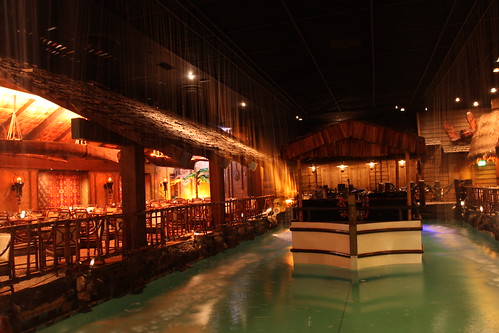
SFGate.com just announced that the Tonga Room in the Fairmont Hotel in San Francisco could possibly be closing soon as the hotel considers converting much of its space into condos (which in this economy doesn’t make much sense, but I digress).
While on the surface this may not have much to do with Asian Americans, the Tonga Room is one of the last vestiges of an era gone by for Asian American nightclub performers in San Francisco. From the 1930s to the 70s, Chinatown in San Francisco was known as having nightly entertainment featuring “exotic” performers from the Orient, even though the vast majority of them were actually 2nd generation Chinese and Japanese American singers and dancers born in both the mainland and Hawaii. This is probably best personified in the movie Flower Drum Song, which featured performers from Forbidden City, the best well known nightclub in Chinatown SF at the time. Arthur Dong did a critically acclaimed documentary on this nightclub called Forbidden City, USA and should definitely be watched if you’re truly interested in seeing how the stuff that Asian American performers dealt with back then hasn’t changed for those trying to make it into showbiz today. A woman who performed during that era tries to bring that time back with her group of performers from those days called Grant Avenue Follies.
When I went to the Tonga Room a few years ago to celebrate a friend’s birthday, it featured a predominantly Asian American band playing covers of cheesy pop songs from the 50s to the 80s and portrayed a romanticized American version of the “Tropics” featuring supposedly Asian fusion cuisine (which ended up being more like lots of deep fried wontons filled with cheese and crab and other deep fried monstrosities), strong and enormous cocktails, and decor from random Pacific Islands, which would horrify most people who have a basic sense of fashion design. Think of Trader Vic’s on steroids. What did strike me about the place (aside from the cocktails that gave me a nasty hangover the next day) was the fact that almost everyone working there was Asian American and that all of the performers knew that this was totally inauthentic cheese, but had fun with it and played it to the hilt.
Given that the opportunities for most Asian American performers during that time was virtually nil outside of doing these clubs, I did come away with a sense of appreciation that despite their exoticizing Asian and Pacific Island cultures, it allowed Asian American performers back in the day to practice their trade, so it is sad that with the Tonga Room closing, this era will come to an end.
NOTE: 8Asians.com is a community, and we thank you for being a part of it. While we welcome and appreciate differences in opinion, if you're rude or you're promoting spam, we have a right to edit or delete your comment. Read our comment policy for more information.
If you see a comment that violates the 8Asians.com comment policy, you may flag the comment by mousing over the comment and clicking "FLAG."
Efren: Great post and I had NO idea about the connection to 50's era Chinatown and the Tonga Room. You did, however, forget the coolest part of the bar; THE FACT THAT IT RAINS INDOORS EVERY HOUR.
OHMYGOD, HOW THE FUCK CAN A CITY SHUT A PLACE DOWN THAT RAINS INDOORS. Do you know where else it rains indoors? Disneyland. And a city would NEVER shut Disneyland down.
Efren: Great post and I had NO idea about the connection to 50's era Chinatown and the Tonga Room. You did, however, forget the coolest part of the bar; THE FACT THAT IT RAINS INDOORS EVERY HOUR.
OHMYGOD, HOW THE FUCK CAN A CITY SHUT A PLACE DOWN THAT RAINS INDOORS. Do you know where else it rains indoors? Disneyland. And a city would NEVER shut Disneyland down.
Jason: Thanks! Considering that there's so much about Asian American culture pre-1965 that's virtually ignored by most people (except people who've done Asian American studies like myself) even in SF, it's not a surprise that many people are unaware of the lessons learned from that era--particularly, that one has to make one's own opportunities to succeed in one's chosen field, especially if it's entertainment. The whole history of nightclubs in Chinatown SF is totally fascinating, and I made it a point to teach it when I was teaching Asian American studies to help my students realize that we're not the first generation of Asian Americans trying to be entertainers.
Yes, it is cheesy, but the Tonga Room is awesome. I can't believe the San Francisco Historical Society is going to let the Fairmont destroy this place. @Efren: Great post BTW.
Feb 16: Adam WarRock and Kirby Krackle: West Cost Tour Dates!!!
Feb 17: (Los Angeles, CA) All My Sons
Feb 18: (Stanford, CA) Stanford’s 16th Listen to the Silence Conference
Feb 25: (Los Angeles, CA) Past Present I Future Imperatives: Queer Space Time
Mar 3: (New York, NY) Vong Pak’s ‘Electric Shaman’ Concert
Apr 30: (Sacramento, CA) California Asian Pacific Islander Policy Summit 2012: iAdvocate