
8 Asians

  • About us
  • Write for 8Asians
  • Podcast
  • Events
Meet the 8Asians: LianneMeet the 8Asians: Lianne
An Asian Girl’s Definition of HerselfAn Asian Girl’s Definition of Herself
Election 2012: Asian Americans Voter Turnout Declined from 2008 and Lowest Amongst All RacesElection 2012: Asian Americans Voter Turnout Declined from 2008 and Lowest Amongst All Races
The Death of The Two USC Chinese Students: Whose Fault Is It?The Death of The Two USC Chinese Students: Whose Fault Is It?

The Difference Between Internment Camps and Concentration Camps

By Koji Steven | Wednesday, August 24, 2011 | 7 Comments

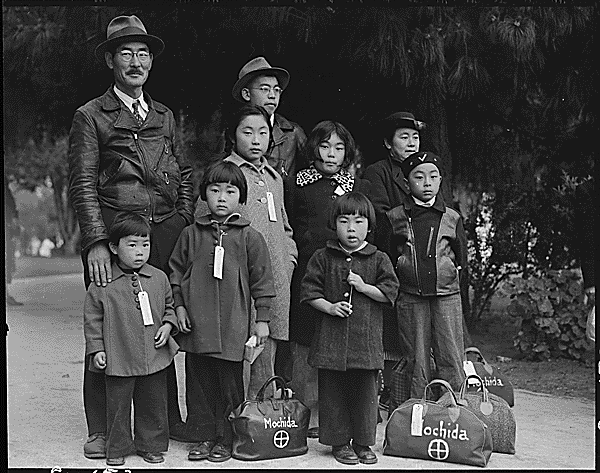
japanese american internment   members of the mochida family awaiting evacuation 1942 The Difference Between Internment Camps and Concentration Camps

[Author's note: Although I am employed by the Japanese American National Museum, this article should not be construed as coming from the National Museum. Instead, this article is my personal opinion and should be taken as such.]

Over the last month, I have posted articles about my grandfather and what happened to him during the Second World War. Much of my grandfather’s story was not unique. Approximately 120,000 Japanese Americans were illegally incarcerated during the war, their only crime was looking like the enemy. The majority of those incarcerated were American citizens.

When most people refer to where the Japanese American were held, they use the term: internment camp. But the term is not only inaccurate but also hides what they really were: concentration camps.

Before you get angry or offended, let me explain.

According to the Merrian Webster dictionary, a concentration camp is “a camp where persons (as prisoners of war, political prisoners, or refugees) are detained or confined.” The definition of a concentration camp describes exactly what happened to the Japanese Americans during WWII, where they were political prisoners confined in a camp.

One of the reasons people are reluctant to use the term is because they don’t want to imply what happened in the United States was similar to what happened to Jews and others in Europe. But I believe what happened in Europe was not a concentration camp but much much worse. A more accurate term would be “death camp,” because the main purpose of the European camps was to torture and kill its prisoners.

In the book, Common Ground: the Japanese American National Museum and the Culture of Collaborations, the Museum curators addressed this debate:

A “concentration camp” is a place where people are imprisoned not because of any crimes they committed, but simply because of who they are. Although many groups have been singled out for such persecution throughout history, the term “concentration camp” was first used at the turn of the century in the Spanish American and Boer Wars.

During World War II, America’s concentration camps were clearly distinguishable from Nazi Germany’s. Nazi camps were places of torture, barbarous medical experiments and summary executions: some were extermination centers with gas chambers. Six million Jews were slaughtered in the Holocaust. Many others, including Gypsies, Poles, homosexuals and political dissidents were also victims of the Nazi concentration camps.

In recent years, concentration camps have existed in the former Soviet Union, Cambodia and Bosnia.

Despite differences, all had one thing in common: the people in power removed a minority group from the general population and the rest of society let it happen.

It should be noted that United States government and military officials (including the President) often referred to these places as concentration camps. It is also important to note that not all Japanese Americans agree with the use of the term. Some Japanese Americans would prefer to use the government terminology. Although I disagree with them, it is their right to do so.

If concentration camps is the historically most accurate term, is saying interment camp wrong? Yes, because internment camp is a euphemism. According to the Merrian Webster dictionary, a euphemism is “the substitution of an agreeable or inoffensive expression for one that may offend or suggest something unpleasant.” A good example of a euphemism is saying someone was “eliminated” versus “killed.”

Think it doesn’t make a difference? What images are evoked when you hear concentration camp versus when you hear internment camp? Internment seems benign at worst while concentration camp is always construed negatively. That difference is intentional.

Mako Nakagawa, a former teacher and Japanese American activist, spoke about the negative effects of the euphemism on the general perception of the World War II experiences of Japanese Americans in an interview with the Nichi Bei, a Japanese American newspaper:

Government-created euphemistic language led to some people actually believing that the Japanese Americans were being protected and even pampered in the camps. The use of inaccurate terms can, and too often does, distort facts into outright fantasies.

The old adage that “sticks and stones may break bones/But words will never hurt” is not true. Words have power. They can create and they can destroy. Every time I write anything, whether it’s a screenplay, blog, or email, I remember the following quote from Pearl Strachan to remind myself how important my words can be: “Handle them carefully, for words have more power than atom bombs.”

Internment camp wasn’t the only euphemism. Here is a short list of some of the other more egregious ones:

  • Evacuation/Relocation versus what it really was a forced removal.
  • Assembly Center/Relocation Center versus what it really was a prison.
  • The idea of a non-alien as referred to in the evacuation order versus the more common term citizen.

This last one is so unbelievable (and not very well known), I feel it is important to expand on it a little. In the evacuation order, it states:

All Japanese persons, both alien and non-alien, will be evacuated from the above designated area by 12:00 o’clock noon Tuesday, April 7, 1942.

If an alien is someone who is not a citizen, a non-alien is a citizen. But they couldn’t say, “All Japanese person, both citizen and non-citizen will be evacuated” because it would be too obviously unconstitutional. But if we say non-alien most people wouldn’t give it a second thought.

Hiding the truth of what happened behind euphemistic language doesn’t allow us as a country to learn from our mistake and make sure it doesn’t happen again. That’s why when people ask me about my family’s experience in World War II, I always make sure to start by saying that they were incarcerated for almost six years in America’s concentration camps.

If you want to learn more, I recommend reading Words Can Lie or Clarify: Terminology of the World War II Incarceration of Japanese Americans by Aiko Herzig-Yoshinaga. (Aiko was one of the people responsible for proving that the incarceration of Japanese Americans was not based on a military necessity but racism.)

Finally, Mako Nakagawa will be speaking at the Japanese American National Museum on August 27, 2011 at 2pm. She will discuss euphemisms and the importance of using accurate terminology.

Thanks for rating this! Now tell the world how you feel - Share this on Twitter and on Facebook.
(Nah, it's cool; just take me back.)
MOODTHINGY
How does this post make you feel?
  • Excited
  • Fascinated
  • Amused
  • Bored
  • Sad
  • Angry

Categories:

DiscriminationHistory
Tweet

NOTE: 8Asians.com is a community, and we thank you for being a part of it. While we welcome and appreciate differences in opinion, if you're rude or you're promoting spam, we have a right to edit or delete your comment. Read our comment policy for more information.

If you see a comment that violates the 8Asians.com comment policy, you may flag the comment by mousing over the comment and clicking "FLAG."

Facebook Comments (Beta)

  • Spudguy

    I don’t think the issue is with the specific words, though I do get your point. At this stage, the words have their connotations, and shifting them would be an uphill battle.

    The bigger issue, as I see it, is how history is taught around this.

    History (at least how I was taught in school), says something like this:
    - The Japanese did a sneak attack on Pearl Harbor. (I note that plenty of movies highlight this action)
    - America entered the war and retaliated against the enemy with atomic bombings. Japan resisted, but after the 2nd bombing relented.
    - [the takeaway by many is that the 'Japanese' were sneaky and stubborn, and that's the historical portrayal of all things Japanese]

    Instead, history lessons should consider also this:
    - Over 100,000 Japanese Americans were imprisoned in camps. In retrospect, this was a human rights and constitutional violation. Reparations were offered under the Reagan administration, 40 years later.
    - During the war, 20,000 Japanese Americans served their country (America), including the 442nd Combat Unit, consisting primarily of Japanese American citizens fighting in the European theater.
    - Despite their families and brethren being imprisoned in camps, the 442nd unit served loyally and are **the most decorated unit in US Military History**

    The above, though certainly a more tactical detail, provides a more balanced portrayal and differentiation of race vs. national positions.

    As an additional historical note, I think the internment period lasted more like 2-3 years, not 6. I think it started with executive order 9066 which was issued in early 1943, and then ended sometime in 1945.

  • ksakai1

    @Spudguy Thanks for your note… some people were put in camps before EO 9066 (which was issued in Feb 19 1942) and some people were still incarcerated after the end of the war. My family was one of those families.

  • http://www.twitter.com/JoshSzrmeiack JoshSzmezrmeck

    How interesting. I just wrote an essay completely destroying the U.S’s decision to set up the concentration camps. I was quite proud of it; it was almost a full-blown rant, albeit a well sourced and evidence thick rant XD

  • http://www.8asians.com/author/akrypti/ akrypti

    I would like to know which asshole clicked “Bored.”

  • Pingback: Asian American Commercial Watch: Bank of America’s Uwajimaya profile | Entertainment | 8Asians.com

  • Pingback: Top 10 Iconic Japanese American Photos | History | 8Asians.com

  • Pingback: Debating the Term “Concentration Camp” » Members of the Scribe – My Jewish Learning

 
Google
Custom Search
Advertise on 8Asians
Recent Posts
  • I am South Indian, Hindu, Buddhist, American… But Am I Asian, Too?
  • Chef Ming Tsai & White House Executive Chef Cook Healthy for American and Pacific Islander Heritage Month
  • Meet the 8Asians: Nithin
  • Asian American Commercial Watch: Ace Hardware Neighbors
  • Lucy Liu, Hollywood Asian Stereotypes, and “Elementary” (my dear Watson)
  • An Asian Girl’s Definition of Herself
  • 8Asians Vlog from Lianne: Reverse Culture Shock
Recent Comments
  • Don: I can make a killer homemade delicious fried rice. I would use sesame oil, white rice, soy sauce, sliced chicken, roast beef and shrimp with... – Chef Ming Tsai & White House Executive Chef Cook Healthy for American and Pacific Islander Heritage Month
  • KAMIKAZIPILOT: Never liked Lucy Liu as an actor as I just don't find her interesting to watch. I don't know about anyone else but I've always... – Lucy Liu, Hollywood Asian Stereotypes, and “Elementary” (my dear Watson)
  • Don: Never been to Ace Hardware and I find more good deals and selection from Home Depot and Lowes. I find other good hardware tools deals... – Asian American Commercial Watch: Ace Hardware Neighbors
  • LTE2: "Low profile, make money, rise to hidden elite status" . You can run but you can not hide. The left employs cash sniffers and they... – Election 2012: Asian Americans Voter Turnout Declined from 2008 and Lowest Amongst All Races
  • Tina Tsai: LOL nice – Lucy Liu, Hollywood Asian Stereotypes, and “Elementary” (my dear Watson)

APA Events

  • Feb 21: (San Jose, CA) New Stories from the Edge of Asia: This/That
  • Apr 26: (New York, NY) Front Row: Chinese American Designers
  • May 2: (San Francisco, CA) underCurrents & the Quest for Space
  • May 23: (San Jose, CA) Sake San Jose 2013
  • May 23: (San Francisco, CA) Asian Art Museum: Terracotta Warriors Private Tour & Dinner
  • Jun 1: (San Francisco, CA) Northern California Soy and Tofu Festival 2013
  • Jun 1: (San Francisco, CA) Asian American Bone Marrow Registry Registration Drive – 2013 Soy and Tofu Festival
  • Jun 6: (San Jose, CA) Questions from the Sky: New work from Hung Liu
Add Your Event
www.8asians.com

Staff and Contributors

  • Editors
  • Jocelyn "Joz" Wang

    Editor-in-chief/CEO
  • Moye Ishimoto

    Editor-at-large
  • Contributors
  • Tina Tsai

    LATEST POST: Lucy Liu, Hollywood Asian Stereotypes, and “Elementary” (my dear Watson)
  • John L.

    LATEST POST: Chef Ming Tsai & White House Executive Chef Cook Healthy for American and Pacific Islander Heritage Month
  • Shako Liu

    LATEST POST: LAAPFF 2013: Mix-cultural Asians Find Their Roots
  • akrypti

    LATEST POST: Meet the 8Asians: Nithin
  • Jeff S.

    LATEST POST: The “it’s ok” Campaign Counters Stigma of Mental Illness
  • Tim Chiu

    LATEST POST: Behind the Smoke and Mirrors of Chinese Superstition
  • Koji Steven Sakai

    LATEST POST: Five Non-Asian Asians
View all Authors

Other Links

  • Get your very own 8Asians merchandise here!
Advertise | Contact Us | Twitter | Facebook | Tumblr | Privacy Policy