
 Back in 1997, when I first met my most recent ex, one of the biggest trends among queer Asian men in SF was bleaching one’s hair blond. Lest it be seen as a knee-jerk reaction to queer people of color wanting to be white to be more accepted by queer white people like I discussed previously, it was actually very popular among Asian men who identified as preferring other Asian men. Despite the burning scalp, the eventual turning of the hair orange if you used cheap-ass materials, it was simply a fashion trend to shock an already shocked Asian mainstream that we queer men existed. I got rid of it a few months later, sick of having to use conditioner on my fried hair, and also because it soon became popular among straight Asian men, which is an immediate sign that it’s passe.
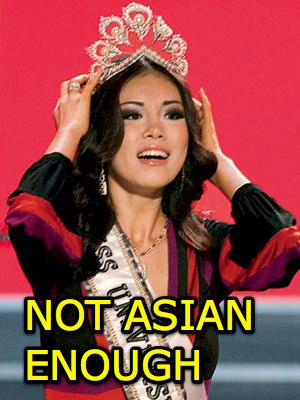
Marie Claire, one of the more famous and respected beauty magazines out there, recently did a report called Erasing Ethnicity. The group of articles presented which while primarily focusing on people of color who wanted to become “beautiful” by appearing more “American”, does a great job for a mainstream magazine by asking more complex questions about people of color and the concept of beauty. From the extreme plastic surgeries that people will do to become more beautiful (not just blepharoplasty, but calf shortening and leg lengthening), people of mixed ethnicity becoming more prominent and considered more beautiful, to straightening and bleaching one’s hair, to Japan’s Miss Universe being criticized for not being Japanese enough, the group of articles poses an interesting question: what determines standards of beauty–whiteness/American-ness or wealth?
On the one hand, again, the knee-jerk reaction appears to be that “beauty” is having features that are considered more white. Personally, I’d like to argue that it’s “difference” in its various forms that’s considered more beautiful, which some argue is a product of sociology, and others biology. Being different is seen as changing the gene pool, meaning that if one looks different and is successful he or she is more likely to survive in changing environments. When I read the articles, I got the impression that it’s being able to have the disposable income to get the surgeries, to have the tanned skin, to become a few inches taller that makes the people who get these procedures beautiful, and not necessarily the end result.
That being said, I still think that many people of color haven’t really thought about this to any critical degree. I remember getting into many arguments with my mom about why she didn’t want me to swim in the summer for fear of me being too dark. Whenever I challenged her, asking, “So you think I’ll be black?” or “Do you really want me to be white?”, my mom didn’t have the language to explain this, and she often waved me off, because she didn’t want to think about it.