
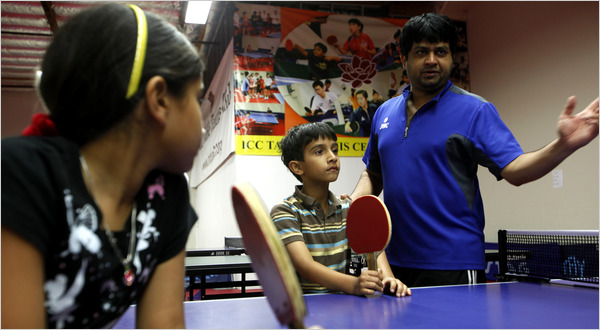
While growing up, my family had a ping pong table in our basement — my brother and I would often play during the summers, when we had a lot of time during our summer vacations and when it was nice and cool. I eventually played competitively, once at the Bay State Games and played a little at my university’s table tennis club.
Table tennis has never really gotten a lot of respect or been taken seriously in the United States, and is often referred to as “ping pong.” Until most recently, all American table tennis players who have represented the United States have been naturalized Chinese-born table tennis athletes and often, American table tennis athletes go abroad to train competitively. But in the heart of Silicon Valley in Milpitas, California, the country’s largest youth table tennis training program and facility has recently opened, run by the India Community Center, according to reports in the New York Times:
“…the India Community Center’s Ping-Pong facility was started last year with seed money from two Indian entrepreneurs and has already become an influential hatchery for Olympic hopefuls, most of whom banter in Hindi or Mandarin at home… The program started small in 2005 with five Indian players. “The Chinese people didn’t want to learn table tennis from some Indian,” as Mr. Sheth put it. Winning 16 medals the following year at the Junior Olympics helped persuade the Chinese of the India Community Center’s serious intentions. Today parents have nicknamed it “the India-China center.”
I was surprised to discover that table tennis was invented in England, and not in Asia, even though Professor Min Zhou, a UCLA professor of sociology is quoted in saying that table tennis “is a sport where [Asians and Asian-Americans] have an advantage because of cultural affinity.” 80% of players age 14 and younger are Asian-Americans, according to USA Table Tennis.
The professor also cited that there is a perception amongst Asian American parents that their children would not excel at football or basketball — thankfully, Jeremy Lin is helping to break that stereotype — and that table tennis is a sport that their kids can be active in and overcome the stereotype of being nerdy. Hello? Most Americans don’t consider table tennis a sport. In fact, I think most would think of table tennis the nerdiest of all sports. Maybe more nerdy than badminton (though if you’ve ever watched competitive badminton, it is very demanding physically.) And as much as I enjoy playing table tennis, personally I’d rather have more Asian Americans playing football or basketball so we can see more Jeremy Lin’s on the basketball courts.
NOTE: 8Asians.com is a community, and we thank you for being a part of it. While we welcome and appreciate differences in opinion, if you're rude or you're promoting spam, we have a right to edit or delete your comment. Read our comment policy for more information.
If you see a comment that violates the 8Asians.com comment policy, you may flag the comment by mousing over the comment and clicking "FLAG."
For those of who are unaware there is a fun movie "Ping Pong Playa" that examines the California Asian Table Tennis subculture and also deals with the challenges of overcoming steroetypes. Definitely worth adding to your Netflix Queue - it's available to watch online.
http://www.netflix.com/Movie/Ping_Pong_Playa/70...
A sport can be nerdy if others perceive it as nerdy ... i.e. oh, "ping pong" are for Asians - they are for nerds ...
I agree that Asians in general are shorter - but how about those who are not. I do not agree that just because you are shorter mean that you are not athletic.
"In fact, I think most would think of table tennis the nerdiest of all sports"
how can a sport be nerdy again?
It's a known fact that in general, Asians are shorter, smaller, and not athletic enough to compete competitively with others. Even whites are generally disadvantaged in the athleticism part.
How is that a "fact?" It's just a stereotype and one that I have seen disproven as I have seen more and more Asians getting involved in basketball. Getting back to table tennis and even badminton, if you look at high level play, how can you dismiss those folks as unathletic? As for "in general," make a sweeping generalization like that is hard to prove. If I am wrong, I'd like to see some evidence of that.
"The professor also cited that there is a perception amongst Asian American parents that their children would not excel at football or basketball"
How is that only a perception? It's a known fact that in general, Asians are shorter, smaller, and not athletic enough to compete competitively with others. Even whites are generally disadvantaged in the athleticism part.
Nice post. In my company's gym in Silicon Valley, the table tennis club has reserved times and usually has a lot of Asian American players who use that time. They work up a pretty good sweat as they usually pretty intensely. Definitely a sport to me! I didn't know you played competitively. That's pretty cool.
And as much as I enjoy playing table tennis, personally Iu00e2u0080u0099d rather have more Asian Americans playing football or basketball so we can see more Jeremy Linu00e2u0080u0099s on the basketball courts.
While I'd also like to see more Jeremy Lin's, I have negative feelings about football, given the health hazards of tackle football (e.g. concussions) and the way that it consumes college and high school resources at the expense of academics and other sports. To me, a key goal of sports, especially youth sports, should be to encourage exercise by teaching enjoyment of sports that can be done for a lifetime. Football (tackle) isn't something you can do for a lifetime and typically excludes half of the population (women). Flag football is a different story, and can include females too (my son has played against girls in flag football tournaments and games). Table tennis and badminton too can played for a lifetime, and I'd rather have people getting exercise all of their lives by playing sports that some might consider nerdy rather than encourage half of them them to play a sport that doesn't promote long term or even short term health.
Feb 16: Adam WarRock and Kirby Krackle: West Cost Tour Dates!!!
Feb 17: (Los Angeles, CA) All My Sons
Feb 18: (Stanford, CA) Stanford’s 16th Listen to the Silence Conference
Feb 25: (Los Angeles, CA) Past Present I Future Imperatives: Queer Space Time
Mar 3: (New York, NY) Vong Pak’s ‘Electric Shaman’ Concert
Apr 30: (Sacramento, CA) California Asian Pacific Islander Policy Summit 2012: iAdvocate