
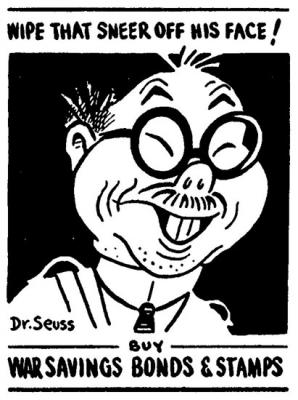
Think of this as a public service announcement: Dr. Seuss was a racist. Yes, the lovable creator of all those wonderful childrens books was bigoted.
Check out some of his lovely cartoons here – most people don’t know that during the Second World War Dr. Seuss made political cartoons that were not only flat out anti-Japanese, but anti-Japanese American. I get the anti-Japanese sentiment; we were at war with the country of Japan. (I don’t think it was right, but I get that.) What I can’t forgive though is his anti-Japanese American cartoons. He — like too many people of his day — didn’t understand that there was a fundamental difference between those from Japan and those that were born and living in the United States. The most offensive cartoon shows Japanese Americans waiting in line to get instructions from Japan; the idea, of course, being that our loyalties were in question. Needless to say, he did not make similar cartoons for people of Italian or German descent. I wonder why.
Because of these cartoons, I will never read a Dr. Seuss book to my child. I will not even allow one in my house.
NOTE: 8Asians.com is a community, and we thank you for being a part of it. While we welcome and appreciate differences in opinion, if you're rude or you're promoting spam, we have a right to edit or delete your comment. Read our comment policy for more information.
If you see a comment that violates the 8Asians.com comment policy, you may flag the comment by mousing over the comment and clicking "FLAG."
I don't in any way condone racism, but I think under the circumstances these things can be contextual. A lot of this thinking may have been a product of the time, which was definitely influenced by fear. Ignorance and fear go hand in hand. Well, maybe I'm just giving him far too much credit, though. The Japanese-American one is especially offensive.How do people feel about separating the artist's personal life from his work? Bukowski, a well-know misogynist, could write some of the most beautiful and moving poetry. Michael Jackson may or may not be a pedophile, but does that make his music invalid? All of us do great and terrible things, but does one forever mar or negate the other?
This is a joke, right?
I think Dr. Seuss is not a racist. This is just a issue that attempt to destroy the good author's image.
I remember in the early 1990s being at a Japanese-American friend's house for a party of Japanese-American journalists, a number of them being colleagues of mine in the newsroom. I was the only "white" person present. I heard a great many snide jokes and comments made about caucasians. I remember thinking at the time: "Hey, standing right here!" Now I know these same people who worked with me, invited me to the party, etc., liked me personally. But they were blind to their racism. It cuts both ways.
I don't want to excuse any racist cartoon drawn by Dr. Suess -- and from what I know I don't think he would excuse himself -- but, its difficult to fault someone who was reflecting the attitudes of his time. It's not as if he was the prime mover in these attitudes in the US.
It might be a good idea to look at all his cartoons. (http://orpheus.ucsd.edu/speccoll/dspolitic/Fram...) Its easy to look back now since the US won, but, I don't think that was clear at the time. I'm sure it was a scary time. Some of that fear was justified, other expressions of that fear clearly wasn't, and some of that fear was exploited by others who wanted to get rid of the Japanese/Japanese American population from the West Coast for a long time before WWII. And, Dr. Seuss, not being from the West Coast (he only moved to California after the war) and who probably had little contact with any Japanese/Japanese Americans might not have been aware of the larger social forces driving racism against Japanese Americans on the west coast -- he was probably more the one being influenced than the influencer in this case. You state "like many people of his day" But, did anyone of non-Japanese decent stand up to oppose these attitudes? Isn't passively doing nothing in the face of racism if you know its wrong the bigger evil? If so, wouldn't you have to condemn virtually everyone living in the United States during WWII just like you do Dr. Seuss.
I trying not to make a judgement on your ideas nor your decisions on how to raise your children, as it isn't my place to say one way or the other, and your conclusion is justifiable. However, there is a larger context involved -- not the "Japanese attacked the US, so how can you blame them," but a larger history of migration, racism, regionalism, exploitation, fear, and ignorance that led otherwise progressive individuals during WWII such as Dr. Seuss to draw such cartoons.
(Also, German/German Americans in WWII might not have had it as bad as Japanese/Japanese Americans, anti-German sentiment ran pretty high during World War I. (http://en.wikipedia.org/wiki/German_American#Wo... for example and, if you haven't read it, John Dwyer's War without Mercy talks deeper about the development of anti-Japanese feelings in America and anti-American feelings in Japan and how they were expressed in the media of both countries.)
I'm white and knowing about Seuss's racism makes me very, very sick to the stomach. I do not think it was remotely excusable. No amount of bad actions from the Japanese empire excuses a single piece of the layers of race-focused propaganda produced by our government. (And none of those government folks, or cartoonists like Seuss, seemed to notice the irony that Nazi Germany's prime evil was a racism writ large u00e2u0080u0094 there ain't really much different between a US anti-Japanese poster and a German anti-Jew poster.)
One thing I do have to say is this: If we had to reject all the art and thought of all past racists, well, we wouldn't have much left from the past to read. For example, one of my favorite philosophers, David Hume, let his empiricism out the window for the sake of a private racism. TS Eliot was an antisemite. Charles Darwin arguably said some racist things (although he was progressive for his time). And many of those American founding fathers that USans love to quote for their exalting of liberty? Well, we all know they kept slaves in the backyard, and, well, they didn't exactly pick those slaves based on the content of their character. It's a stain on them all.
I think it is possible, though difficult, to separate the man's work from, well, the man's other work (and by extension, from the man). In all probability, Dr. Seuss's books, which include some excellent parables against racism, have produced more anti-racist enlightenment in the current generation than his cartoons added to the bigotry of the "Greatest" generation.
While I personally would never keep his books from kids, I cannot begrudge or fault your decision there.
(After reading over what I wrote, I feel bad that my examples of historical racism are more African-America focused, but that's my education on the subject. When it comes to the history of anti-Asian-Americanism, I don't know about much more than the WWII stuff, although I'm sure there's a lot more. I know there's a lot in the present.)
There's a bit in "If I Ran the Zoo" (1950) where Suess talks about a land where "people all wear their eyes on a slant," and I always skip that paragraph when I read it to my son.
Not sure. I remember reading about the camps in school, but I don't remember if there was martial law. Too lazy to look it up at the point of night too.
Amusingly enough, I have to say that it wouldn't be the first time the whole looks thing constituted as behavior that shouldn't happen. For example, look at 9/11 and when people started to lynch random dark skinned people that looked like they might be from the Middle East. Or heck, the even better one.... "all Asians look alike." Which I might add, I can vouch for time and again where I live. People can't tell the difference because frankly some of them probably don't care to tell the difference.
So during the time of WWII, I'd probably say the if you apply the same mentality? Regardless of if you're Japanese or Japanese American.... some would stop at just the first three letters and make a decision.
Like Moye, I have to say that there are many instances and layers and it's not as black and white. Personally, when I read it, I kind of grouped this in the same arena as when I was a kid and heard the stories of how the Japanese occupation did to some of my family in my grandparents age and when they fled from communism to HK and Taiwan. Some of that generation still hate the Japanese (any Japanese), and knowing what sort of traumatic experience that they went through, I can't blame them for it although I don't share the same sentiment.
While you shouldn't group individuals into large impersonal entities that make it easier to hate or what not, sometimes it's based on situations and experiences.
I think understanding why Seuss felt the way he did at the time, and why he had a change of heart later on, is what the underlying message really should be. Everyone has skeletons in their closets, and everyone has done something that they've probably regret. But the past doesn't necessarily dictate the person's future. I think that actually should be the lesson taught here.
Oh, and one last thing? Being human requires you to be stupid sometimes. Everyone's done it. Except maybe Moye and Joz. :p
As a fellow 4th generation Japanese American whose family was also incarcerated, I do agree that we have a right to be sensitive about the subject. It's a part of history that I hope my own kids will never forget. It's never okay to act stupid during a time of war, and I'm not excusing such behavior. But it happens. Maybe I don't see racism as such a black and white issue (no pun intended): there are many layers and gray areas, and it's more than just a good vs. evil sort of situation.
But how does you stand knowing that Seuss later regretted his political cartoons, according to the interview that Joz quoted? Or that he dedicated one of his most popular books to his friend in Japan? A lot of his books can also be interpreted as morals for tolerance. Maybe using his story as someone who once used art to portray his own intolerance but learned from his mistake (or maybe even showing that all people, including celebrated authors as Dr. Seuss, come with flaws) is a better lesson to teach your children than outright banning him.
Ben, I stand corrected. But I was speaking more in hyperbole than in constitutional law. :) There was martial law in Hawaii for sure, but not sure about the west coast.
I should have said... "all these right can be taken away because you look like the enemy."
Here comes the correction. Constitution can be suspended in a state of martial law. Now as far as I know, there wasn't martial law declared, but as far as that comment is concerned, there are clauses that do remove the rights. Doesn't have to be in war obviously to have martial law enacted.
Thank you for your comment. I appreciate where you are coming from but will have to disagree. Is it knee-jerk? Sure. But as a fourth generation Japanese American who's father's family was incarcerated from December 1941 to June 1948, I think I have a right to be a little sensitive about the subject. And I will teach my children that during times of war, it is not okay to lose your head and be stupid.
But you're making the same mistake he did... you are lumping in Japanese Americans and Japanese into the same group. Those are two very different groups of people. The Simpson report (done before the war) indicated that the Japanese living in the United States were not going to be disloyal. The incarceration of the Japanese was done because of racism, paranoia, and economic factors.
Besides which, I don't want to get into the whole Bill of Rights/Constitution. As far as I know (and please correct me if I'm wrong). Those documents don't have a clause that says "all these rights can be taken away in case of war."
I'm not excusing the racism, but living and working during World War II was a very different culture. Could it be that he was producing these cartoons featuring popular ideas at the time to generate income? How do you explain his other works that make political statements against racism? I think the story would be quite different if he had been producing these cartoons after the war was over, or presented the same ideology in his books for children.
If that was true, I'd understand your sentiment. But it's not. Wouldn't it be more proactive to share his books with your kids, which do have a lot of valuable lessons, but also explain his background as an artist?
I think this is a really knee-jerk reaction. There are plenty of artists and writers that you should shield your children from, but I have a hard time including Dr. Seuss in that group.
Although Dr Seuss wasn't able to separate Japanese from Japanese-Americans during the war, it was reported that he may have regretted these works later on.
The below is from an interview done with the filmmaker of "The Political Dr Seuss," Ron Lamothe:
Q: On the World War II political cartoons for PM and propaganda films for Frank Capra's Signal Corps: did Geisel come to regret some of the racism displayed in those pieces, especially since race was a theme of American culture and politics (in The Sneetches and even somewhat in Horton Hears a Who) that he took an interest in?
RL: That's a really good question, and I wish I knew for sure what the answer was. The only evidence I have comes from his biographers, who told me that years lateru00e2u0080u0094although still recognizing its necessity due to the waru00e2u0080u0094he was regretful about some of his cartoons for PM and some of the propaganda work he did for the Army Signal Corps. I do think the fact he dedicated Horton Hears a Whou00e2u0080u0094a parable about the American postwar occupation of Japanu00e2u0080u0094to u00e2u0080u009cMy Great Friend, Mitsugi Nakamura of Kyoto, Japan,u00e2u0080u009d says something of his changing attitudes toward the Japanese (this following a trip he made there in 1953). Though, as Richard Minear has pointed out, Horton Hears a Who still smacks of American chauvinism, and it makes no reference to Hiroshima and Nagasaki.
Anyway, your post inspired me to write this:
Dr Seuss is a louse;
You will not have him in your house.
You will not read him to a mouse.
You will not show him to a grouse.
For racist views did he espouse!
...If you see Joz stain her blouse, A glass of water, you shall douse!
(Oh wait, that's a different poem)
That said: Clearly, Dr. Seuss' biggest crime was in inspiring people to RHYME POORLY!
Feb 16: Adam WarRock and Kirby Krackle: West Cost Tour Dates!!!
Feb 17: (Los Angeles, CA) All My Sons
Feb 18: (Stanford, CA) Stanford’s 16th Listen to the Silence Conference
Feb 25: (Los Angeles, CA) Past Present I Future Imperatives: Queer Space Time
Mar 3: (New York, NY) Vong Pak’s ‘Electric Shaman’ Concert
Apr 30: (Sacramento, CA) California Asian Pacific Islander Policy Summit 2012: iAdvocate