 When many people think of Asian Americans, especially here in Silicon Valley, they often picture engineers, tech startups, and academic/college-obsessed students. Motorhead isn’t a term that often comes to mind. But if you grew up certain Asian American neighborhoods, import car culture was (and still is) a thing. I was reminded of this when I read an essay by Ky-Phong Tran about his mid-life crisis car. It wasn’t some fancy European sports car or American muscle car, but a heavily modded Toyota Corolla.
Origins of Import Car Culture
Tran explains how some Asian Americans kids in the 90s took relatively inexpensive import cars and modified them to be very fast. I love the way he describes what and why this happened:
The ’90s import car scene was as diverse as Southern California. But there’s no doubt it started with Asian Americans (specifically Japanese Americans in the South Bay city of Gardena) who were influenced by modified car culture in Japan. Soon, Asian American kids all over the region were taking their inexpensive, underpowered 4-cylinder, front-wheel drive Honda Civics (our parents preferred Japanese reliability over American muscle) and turning them into street rockets.
Not only were they building race cars from scratch, they were also building one of my first experiences with a collective Asian American identity. One that wasn’t overtly about politics and activism, or immigration and assimilation. It was about Chinese, Japanese, Korean, Filipino, and Vietnamese American kids having a cool-looking, fast car and going to badass parties where the awful stereotype of Long Duk Dong from Sixteen Candles was shredded into rubber and obliterated by exhaust blasts.
The Fast and the Furious
Import car culture spread to the East Coast and beyond Asian American communities. In 1998, this Vibe magazine article about New York import car racers would inspire The Fast and the Furious Movie. The movie moved the location back to California, but white-washed the characters and turned Asian Americans, who originated the scene, into villains.
Both of these articles are definitely worth reading. Phong talks about other things that The Fast and Furious movie got wrong about the Southern California import car racing scene. The Vibe article has a video with it that talks about the original article (you should see the cover piece that went with it) along with the guy who you could say is the original Dominic Toretto.
A Pan-Asian American Subculture
What I find intriguing about import car culture is an pan-Asian American culture. There really wasn’t anything like it when I was growing up. It’s also a different story than “kids teased me about my lunch box” or “I wanted to be artist but my parents wanted to be a doctor” or “my startup is worth a gazillion dollars.” Shortly after the Vibe article, Susan Kwon published this essay about import car culture in Silicon Valley. Not what people perceive as typical Silicon Valley Asian Americans.
Kaila Yu, author, singer, and also an import car model who appeared in The Fast and the Furious: Tokyo Drive, says in this interview that the import car scene was more than just cars:
SP: Import modeling is a very specific Asian American thing. Taking the model part out, just being at Hot Import Nights as an Asian American person, what was that scene like?
KY: It was a massive phenomenon, because at that time, we had no gathering places for Asian Americans. There was nothing really. But after school, we’d gather in the parking lot at my high school, and all the fixed-up cars would be there. And people would be smoking and hanging out.And then people really started fixing up their cars to another level where they were show worthy. So these shows sprung up, which had hundreds of people at first, and then thousands, and 25,000. It would be the event of the year, where everybody would gather with their cars, and then Hot Import Nights, it was also kind of a party. So then you’d have DJ performances and breakdancing.
Is Import Car Culture Still Around?
Yu argues that The Fast and the Furious movies popularized the scene so much with non-Asians that Asian Americans got crowded out. But is this scene still there? Some say that it is still there but is harder as cars are so much more expensive now. A few years ago that The Daughter mentioned that she brought a white friend to get some ice cream at our local SOMISOMI. In the parking lot was a big import car meet up full of Asian Americans. The white friend wondered if it was safe, but The Daughter reassured her that it was!
I don’t see or hear many of rice rocket” cars around anymore. Still, just around the corner from where I live, there are some Filipino guys who have a whole host of modified import cars and work on them constantly. While the scene isn’t as big as it once was, it still is there.
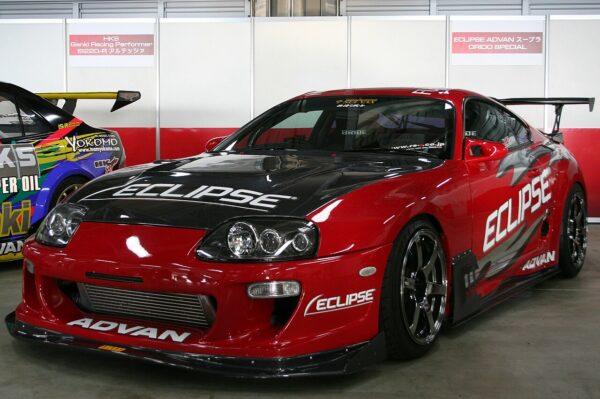
(photo credit: machu. – Eclipse Advan スープラ, CC BY 2.0, Link)


