
8 Asians

Want Relief From Knee Pain? Try Tai Chi

| |


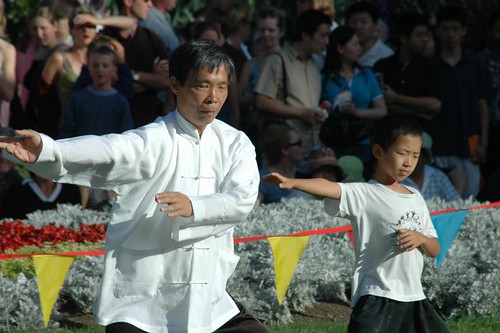
Some news announced at the American College of Rheumatology conference this past week in San Francisco showed that tai-chi was beneficial for relieving pain and disability from knee osteoarthritis compared to the control group that stretched and underwent wellness education. Strengthening the quads, with sustained, slow movements of tai chi showed that the cartilage behind the knee was preserved, alleviating pain and expanding range of motion.

I love how these scientists compared the standard treatment for knee pain with such a non-medical “treatment” of tai chi to see if one would be better. As medical treatments fall short in addressing our aches and pains…for me, dancing has always made me feel better. So wouldn’t it be an interesting study to see how tai chi compares with similar practices? Yoga? Ballroom dancing?

I’m also wondering how much of tai chi relates to the physical benefits of the exercise as opposed to the emotional benefits — does it improve pain because it simply makes the person feel better doing tai chi?

(Flickr photo credit: cheetah100)

What next?

  • Subscribe to this feed
  • Leave a comment

5 Comments to “Want Relief From Knee Pain? Try Tai Chi”

  • Emotions and health are tied together – so it’s probably some of both. At the park where I run, there are lots of older folks who do Tai Chi together every morning. My personal opinion is that much of the benefit that they get is from finding people with whom they can socialize with. There are studies that suggest that one key to longevity and happiness is having active social connections.

  • Jeff, do the people do tai chi and then switch to ballroom later in the morning? I think the transition is amazing–I saw it happen in the parks in Beijing! Really cool.

    Emotions and health are associated; I wonder if tai-chi has an emotional or spiritual component like yoga does?

  • I have never seen the taichi people switch to ballroom, but at the park every Sunday there is a large group of women who dress up in red shirts and white pants and do a form of dance that seems to incorporate some tai chi style moves. I have no idea what they are doing. One large group of tai-chi practitioners does routines to music. My favorite routines to watch are ones where they use fans or swords. Also, I have seen some of the tai chi people move on to doing kungfu or wushu style stuff after they finish. Some people there practice “push hands,” which is also interesting to watch. Needless to say, it’s a pretty cool park with lots happening in the morning, which makes the runs go by pretty quickly.

    Speaking of ballroom, there are a lot of Asians in my salsa class and a lot at salsa and ballroom studios that the Wife and I have visited. I’m not very good though…

  • One more thing – regarding knee pain, one of the things that helped me get back into running was something called chi running (http://www.chirunning.com/). My old roommate, who I nursed through knee surgery when I was in graduate school and he was in law school, told me about it. He used it to run marathons. Chi running combines tai chi principles and body mechanics. I had knee problems that affected my running, and chi running really helped me out.

  • Tai Chi and other forms such as Qi Gong are exercises designed to increase one’s Qi (energy/vitality) to unblock any blockages or obstructions along specific pathways of the body. Simultaneously it helps your body to cleanse itself of toxins and become more aware of your own body. Qi and blood are two sides of the same coin, Qi moves blood.

    The western medical world, specifically the USA, has such a hard time with the concept of Qi because there is no known scientific way to measure or detect Qi. The closest western medical concept related to Qi would be what MDs call “vitality”. Long story short, Qi is in the realm of Quantum Physics and we currently do not have the technology to measure it.
    So for now, we have to rely on empirical evidence and infrared scans and monks who are able to wear practically nothing but somehow able to increase their body temperatures in below freezing temperatures.

    http://www.mayoclinic.com/health/tai-chi/SA00087

    I’ve met Qi Gong masters and felt and seen some crazy things.
    Personally, I haven’t had a cold since I practiced Qi Gong. Anytime I feel like the bug about to hit, I’ll start practicing a Qi Gong exercise specifically for boosting my immune system and eliminating toxins from my body.

Post a Comment

Email addresses are never displayed, but they are required to confirm your comments.

*Required
*Required (Never published)