
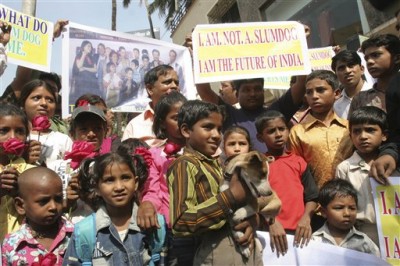
“What movie are you guys seeing?” asked J., a Indian friend of The Daughter.
“We’re going to see Slumdog Millionaire,” said The Daughter.
“Don’t see that – it makes India look so bad!” said J.
It turns out that J. wasn’t the only Indian who didn’t think that Slumdog Millionaire was golden, despite the movie winning four Golden Globes and having ten Academy Award nominations.
This article from the Los Angles Times says that a number of Indians aren’t happy with the portrayal of India in the movie directed by Briton Danny Boyle and was based on a book by Vikas Swarup; critics point out that it is a long line of foreign films portraying India in a similarly negatively light, such as Salaam Bombay and City of Joy. I remember a similar controversy over Indiana Jones and The Temple of Doom over negative portrayals of Indians.
In the larger context, there is a long tradition of negative and distorted portrayals of Asians and Asian cultures by Western art and entertainment, ranging from the opera Madame Butterfly to the controversy over the casting of the Avatar movie. Many questions come to mind also. Are portrayals of a culture by someone outside of that culture somehow less valid than from someone outside of it? Would having an Indian director of Slumdog Millionaire make it somehow more authentic?
Ironically, when The Daughter asked J. one more time if she wanted to see Slumdog Millionaire with her, J replied that she already had seen it!
9 Comments to “Slumdog Millionaire Not so Golden to Some Indians”
Chas wrote:
“Are portrayals of a culture by someone outside of that culture somehow less valid than from someone outside of it? Would having an Indian director of Slumdog Millionaire make it somehow more authentic?”
I think portrayals of a culture by someone outside of that culture are risky, not only of being in error, but also of treading old ground. On the other hand–perhaps not relevant to discussion of this specific film–it is virtually impossible to write about cross-cultural topics without writing about at least one culture that is not ones own. One way to deal with either situation is to get feedback from multiple people within the culture one is writing about, to do research and to be aware of ones own biases. In the case of films (or in my case, plays) a helpful stragegy is to involve people of the cultures involved in the development and production; to be attuned to their reactions, both spoken and unspoken; and to not surround onesself with yes-men and -women.
On the other hand, we can play it safe and most plays and films will continue to involve primarily white actors and stories. This is not an excuse for telling ignorant stories. Still, risk of error is necessary to change this situation and create a space where more accurate stories can be told about a broader range of cultures.
In any case, most films and plays will show something or someone in a bad light, as there needs to be a source for conflict.
Posted on 25-Jan-09 at 2:55 pm | Permalink
Ms. Jen wrote:
Salaam Bombay was written and directed by Indian born immigrants who live in the US/UK. And Slumdog Millionaire’s original writer was Indian born as well.
There are plenty of 1st and 2nd generation Indian diaspora folks writing about the homeland who are being called critical. Are they discounted because they no longer reside in India most of the year?
Posted on 25-Jan-09 at 8:32 pm | Permalink
nemogbr wrote:
Never been to India. I know plenty of people who have and some are Indian descent.
Perhaps Slumdog Millionaire should have shown more of the good side of the country.
At least, they did not linger on the bad parts in graphic detail.
Posted on 26-Jan-09 at 1:44 am | Permalink
Cambodia news wrote:
It’s the same reason that East Asians hated films like Rambo, Joy Luck and the Karate Kid while the white audience loved them. This is nothing new in the American entertainment industry.
Posted on 26-Jan-09 at 9:07 am | Permalink
THE_BANANA_REPUBLIC wrote:
Better Luck Tomorrow offered a way for Asian Americans to present themselves in a negative light. I think it was largely to combat the model minority myth.
Posted on 28-Jan-09 at 5:24 pm | Permalink
Howard wrote:
Just a couple things:
Slumdog Millionaire is a British-produced film, not American.
Salaam Bombay was an amazing film about the poverty of children in India, but the same director, Mira Nair, later made Monsoon Wedding, a popular film in the West that shows what I thought was a positive image of a high caste Indian family.
Posted on 28-Jan-09 at 5:56 pm | Permalink
8Asians.com » India Salsa Fusion wrote:
[...] studios now. Another sign of influence of salsa, IMHO, is that in Jai Ho, the ending song from Slumdog Millionaire, there are parts of the song in Spanish. Did anyone else notice [...]
Posted on 14-Mar-09 at 8:50 am | Permalink
Ray wrote:
There are many unseen considerations regarding why some films (and actors) win Oscars, while some, although heavily favored to, do not. “Slumdog Millionaire” is a good case in point. Take a look at my interpretations concerning “Slumdog”and several more Oscar nominees,winners and “losers,” in “COWBOYS AND INDIANS” at http://sonofthecucumberking.blogspot.com/2009/02/cowboys-and-indians.html
and let me know whether or not you agree.
Posted on 14-Mar-09 at 2:50 pm | Permalink
8Asians.com » Sick of Bollywood Fever wrote:
[...] breaking buzz for a low budget independent film, grossing over $360 million worldwide. However the South Asian Diaspora has many qualms with this film and the subsequent Bollywood fever, and it all feels a little bit too un-comfortable, too cheesy, [...]
Posted on 06-Oct-09 at 3:01 pm | Permalink
Post a Comment