
I recently learned about the following story about John McCain in the Mercury News. At the Navy Academy, an upperclassman was berating a Filipino steward who was serving food in the mess hall. McCain, at that time a lower classman, risked being expelled by challenging the upperclassman, who backed off. There are questions raised by this incident. What does this imply about McCain’s character and how he would be if president? How does this reconcile with his other somewhat alarming comments? Why do the accounts of this story mention a Filipino Steward?
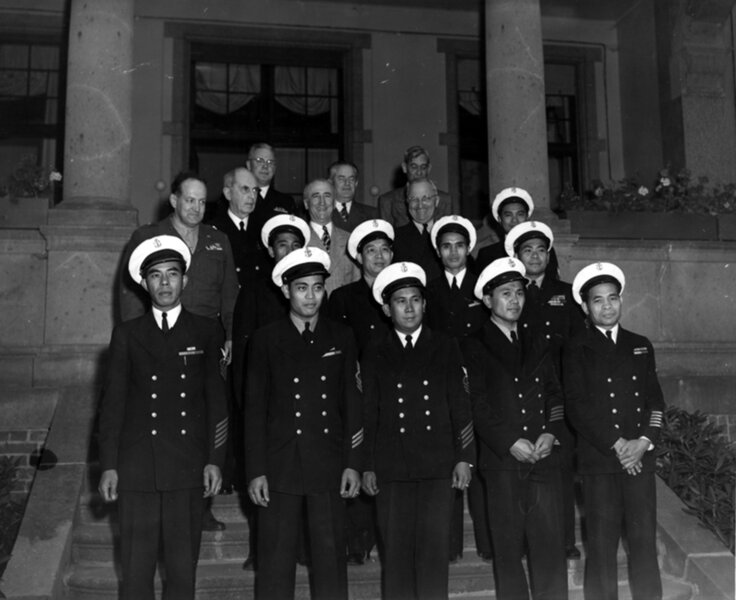
Of these questions, I’ll answer the last one. The United States and the Philippines had a treaty that allowed the US to recruit Filipinos nationals into the U.S. Navy.

These were coveted positions because of the opportunity to go to the US, although for a long period of time, the main job given to these Filipinos was as a steward (read serving personnel). My father came to the US this way, and he spent a few years as an admiral’s stewards (basically a servant). The large Filipino populations around San Diego, Norfolk Virginia, and to an extent, the Bay Area, are because of these Filipino sailors.
My dad put in 20 years, and I grew up around and on Navy bases. Looking back, it was a weird lifestyle — shopping at the Commissary and Exchange, having the military dependents ID card, and going to the military hospital when you were sick. It had some big downsides, like not seeing ones father for months at a time. [Are there any other fellow Filipino navy brats out there who remember flying space available on a military charter to the Philippines? If so, give a shout out!]
My father tells some great stories about his life in Navy. He said that during the Jim Crow era in the South, he and his fellow Filipino didn’t know from which water fountain to drink (“colored” or “white”). He served several tours off of Vietnam, and he was part of the Cuban missile blockade. He still has his sea legs – we visited the USS Hornet (an interesting place to visit if you have the time), and even though he was in his 70s, he moved like a cat, traveling easily up and down the decks and through bulkheads.
After the American bases closed in the Philippines, the US stopped taking Filipinos nationals into the Navy. His generation is getting old, and he and my Mom attend a lot of funerals of Filipino American Navy veterans. I actually thought about writing a book on his generation, but there are already a few books about this era. I’ll read a few and see if any are worth recommending.
NOTE: 8Asians.com is a community, and we thank you for being a part of it. While we welcome and appreciate differences in opinion, if you're rude or you're promoting spam, we have a right to edit or delete your comment. Read our comment policy for more information.
If you see a comment that violates the 8Asians.com comment policy, you may flag the comment by mousing over the comment and clicking "FLAG."
Write a book about them. It would be interesting to know their stories and share your experiences to us. It is worth reading a first-hand information. I would purchase a copy of your book when published.
I think that's what John McCain character! He stands for what is right. I doubt Barrack Obama's sincerity. He is a pure politician and just say anything that's hot for the voters in order to be elected. Kababayan open your eyes, wake up and don't be bought by Barrack Obama's sweet empty promises.
That's how our family came here as well - my dad joined the Navy in the Philippines and retired after 20 years of service just a few years ago. Granted he joined at a later era where the (official) Jim Crow laws no longer existed, but I still remember him telling me that he needed to lose his Filipino accent in order to not be cast aside by the other sailors.
I won't lie, I really do miss the lifestyle - being able to shop at the Commissary and Exchange, basically knowing almost everyone around you. At least where I'm at there's a lot of Filipino retirees - it's helped moving back to Southern California a lot easier.
That's how our family came here as well - my dad joined the Navy in the Philippines and retired after 20 years of service just a few years ago. Granted he joined at a later era where the (official) Jim Crow laws no longer existed, but I still remember him telling me that he needed to lose his Filipino accent in order to not be cast aside by the other sailors.
I won't lie, I really do miss the lifestyle - being able to shop at the Commissary and Exchange, basically knowing almost everyone around you. At least where I'm at there's a lot of Filipino retirees - it's helped moving back to Southern California a lot easier.
Feb 16: Adam WarRock and Kirby Krackle: West Cost Tour Dates!!!
Feb 17: (Los Angeles, CA) All My Sons
Feb 18: (Stanford, CA) Stanford’s 16th Listen to the Silence Conference
Feb 25: (Los Angeles, CA) Past Present I Future Imperatives: Queer Space Time
Mar 3: (New York, NY) Vong Pak’s ‘Electric Shaman’ Concert
Apr 30: (Sacramento, CA) California Asian Pacific Islander Policy Summit 2012: iAdvocate
[...] About 87,000 Filipino immigrants have served in the US Armed Forces (this includes my dad) [...]
[...] gang. He was a year younger than me and grew up close to where I did. Like me, he also had a Filipino dad who had served in the navy. Although we went to the same high school, our lives went in different paths. For example, I [...]
[...] was attending a Memorial Day commemoration for Veterans. I wasn’t surprised, as he was a 20 year Navy Veteran. One thing I’d like to do on Memorial Day is see Uncommon Courage: Breakout at Chosin. [...]
[...] My father talked to them, and I remember being scared because they were so different from the Filipino servicemen the I knew and grew up with. Years later did I learn who those men were and why they seemed so different. They were farm [...]