
8 Asians


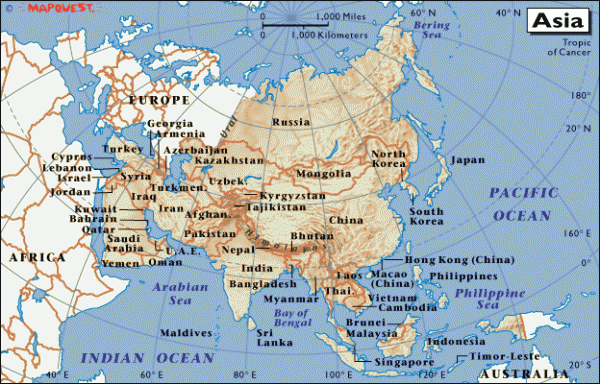
I tried not to take anything they taught me in grade nine geography class too seriously; it was one of those easy courses where the teacher read a National Geographic to herself while you coloured in maps for an hour until the bell rang.  And in my eagerness to shade the shorelines, perhaps I missed the lesson that Asia does not just mean China, Taiwan, Korea, and Japan.  That, in fact, it is the biggest continent on the face of the earth.  I know I most definitely missed the lesson that West Asia is sometimes called the Near East or Middle East, which means that as an Asian, I have something in common with the people being racially profiled here for terrorism.  Could my colouring affinity and consequent distraction have led me to believe that the term Asian only applied to folks who looked like me?

I know in Britain it is common to refer to people from Sri Lanka, India, Pakistan and Bangladesh as Asian, and people from East and South East Asia as Oriental, but then what?  How do you call yourself if you are Saudi? Tajik? Lebanese?

And here, when you don’t fit into a pre-defined category, does that mean you are raceless? Or maybe you don’t exist outside of your own imagination.  On Turtle Island, we don’t even extend the racial term Asian to include people the British system does. How is it that me and others with similar features got to claim the entire continent for ourselves?

Although in this liberal society, individuality and uniqueness as ideas are valued, there is something to be said for feeling like you belong to a group. As a collective, you can mobilize for political change, create and sustain a shared culture, make a blog to counteract racism.  There is societal power in group identification that as individuals, racialized people just don’t seem to be privileged with.  The bigger and more recognized the group, the more power it and the individuals in it have.  Like Asian (and Asian-American, Asian-Canadian).  That’s a pretty big and well recognized group.  The Asians that our view of the category currently excludes don’t have a movement or a category of literature studies and maybe have to fill out the Other section on official forms.  Yet their histories are closely linked with that of Korean, Taiwanese, Japanese and Chinese people, they share many similar forms of racism that East-Asians here have faced, and have struggles that us Official Asians can learn from.

A knowledgeable friend recently told me she heard that the word Asia/n originally meant ‘heathen’.  But obviously we’ve reclaimed that one, right? So maybe it’s time for another change to the word’s meaning. After all, Asia is the biggest continent.  There must be room for us all in its title, and its potential.

What next?

  • Subscribe to this feed
  • Leave a comment

10 Comments to “What Does Being “Asian” Mean?”

  • you might want to consider updating that map – Taiwan is not labeled!

  • I’m Korean and was raised by white people. I used to use the term Oriental but was told that it was offensive. So there is an appropriate occasion to use the word? For people from Indonesia and thereabouts?

  • The word Asian is Greek in origin, and it was used by them as an umbrella term for all the people (from the Middle East to India) they were going to conquer during the time of Alexander the Great.

    geographically, if you look at the physical features of the continents of Europe and Asia, Europe should not be considered a separate continent. If anything, it should be considered an extension of Asia, because Europe is really a peninsula.

    The only physical demarcation between Asia and Europe are the Ural mountains, and that’s not a true indicator of 2 separate continents.

    Europe is the smallest of all the continents, but on flat maps, it looks bigger than it is. If you look on a globe, it will give an idea of how puny it is.

    So what’s all this mean? It means the continent and the term Asia were Eurocentric constructs. It was just Western civilization’s attempt to define what they felt were “the Others.”

    The term Asian has very different meaning now, so the origins of the term is no longer significant.

  • Oh no Ernie! Taiwan is not labelled, what happened? Apologies to all the Taiwanese folks, of course Asia includes Taiwan.

    Re: the term Oriental

    My dad always used the term Oriental to describe what we now call Asian, including himself. It came out the white West’s need to position itself in relation to other great civilizations in Asia, the Orient v.s. the Occident. The white West of course, needing to not just position it self in relation to, but also reaffirm its superiority over. Thus, people see it as a term that has meanings of exotic, alien, backwards, and enemy attached to it. All in all, offensive connotations. In my understanding, people started to self-identify as Asian to bring it back to actual maps and geography that, while still were made by the white West, has less of these negative meanings attached to it. (Dad has started using Asian as well)

    What I am calling for in my post is a re-imagining of the term Asian to not just included what were called Orientals (Japanese, Chinese, Taiwanese, Koreans), but also to include the rest of the continent of Asia. So, as per your example, Indonesians would be considered as Asian as Sri Lankans, Koreans, Palestinians, and Tibetans.

  • Oriental is fine for describing rugs.

  • The term ‘Asian’ is extremely general.

    If people are well educated they would at least acknowledge east, central, south or south-east asia etc.

  • If you really want to be technical and speaking from the history of classified groups, it was the governments of the United States and the UK who made those different distinctions that the OP raised here. For the US government, “Asia” constitutes all the countries from India eastward to Japan, Philippines, Indonesia, Malaysia, etc, and “Middle East” to Pakistan, Afghanistan westward to Israel, Syria, Jordan, etc. In the UK, it becomes even more muddled, since “black” and “Asian” was used to term both South Asians from India, Sri Lanka, etc., while “black” was also used to classify people from sub-Saharan Africa, and “Oriental” for people in East and Southeast Asia.

    Asian American/Asian Canadian is very useful in a political sense, but at the same time, it’s also extremely problematic, since we’re all lumping everyone under “Asia” and more often than not, there’s an assumption that we all have similar backgrounds.

    I also find it interesting that non-Asians are using Asian in very much the same way that Oriental was used and that very few people have called people out on that.

    It’s amusing to me to see how people have always used the term “Asian American” from beyond a political sense to define something cultural, when really it can be argued that “Asian American” as a cultural identity has only now begun to make some kind of sense, even if I still think it’s weird. As for the “reclamation of Asian”, how does one reclaim something that was imposed on us by people outside our cultural and ethnic identities, and thus was never really ours to begin with?

  • Mongolia

  • “I’m Korean and was raised by white people. I used to use the term Oriental but was told that it was offensive. So there is an appropriate occasion to use the word? For people from Indonesia and thereabouts?”

    I think it depends on who you ask. To some, even calling them Asian is offensive.

    I don’t know, maybe just call them by their ethnic groups? Chinese? Japanese? etc. If that’s offensive, then find out what’s not offensive.

  • Ain’t genetics fun?

    Living things, animals, mammals, homo sapiens, asians, orientals, chinese, taiwanese, korean, japanese, gay, straight, rich, poor, smart, dumb. Why is life so complicated? Or do we make it such?

Post a Comment

Email addresses are never displayed, but they are required to confirm your comments.

*Required
*Required (Never published)