
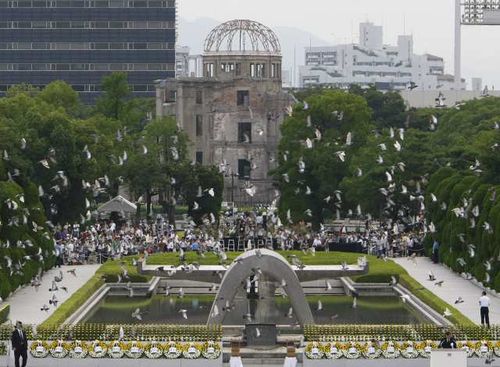
 I was reminded today via the Los Angeles Times web site that today is the 64th anniversary of the atomic bombing on Hiroshima. Having always been interested in the subject ever since I did a term paper on the topic, I was able to visit Hiroshima back in 1994 on the anniversary date, which was quite an experience.
There is nothing quite like seeing the remains of an “atomic bomb dome” building — the most famous of the few buildings left standing within the one and a quarter mile radius of the blast area — fenced off standing still in time with modern Hiroshima in the backdrop, or when I visited the Hiroshima Peace Memorial Museum and seeing a brick wall with the faint outline of a human shadow burned into the wall or a watch frozen stopped in time as the bomb went off.
In a recent poll that the Times referenced, 2,400 registered voters were asked, “Do you think the United States did the right thing or the wrong thing by dropping the atomic bomb on Hiroshima and Nagasaki?” Not surprisingly, the results varried based on their age, gender, ethnicity and political groundings:
“Seventy-three percent of voters older than 55 approved of the decision, and only 50% of voters ages 18 to 34 approved. Seventy-four percent of Republicans said the bombings were a good idea, and 49% of Democrats said so. Seventy-two percent of men approved and 51% of women agreed. The poll found that only 34% of black voters and 44% of Latino voters supported the bombs, although pollsters cautioned that those numbers may not be representative because the polling sample was smaller for those groups.”
Given the circumstances and concern for a land invasion of Japan and the past ferocity of Japanese soldiers on such islands as Iwo Jima, I’m not surprised that the military decision to use the atomic bomb on Japan was made. And no doubt, had the atomic bomb had been tested before the defeat of Germany had happened, the bomb would have been dropped on Germany. Americans don’t also realize that it was important for the United States to drop the bomb to demonstrate to Soviet Union our power, as they were increasingly seen as a post-war threat. But then again, maybe that just help accelerate the Cold War and the concept of Mutual Assured Destruction.
I also had the opportunity on the same trip to visit Nagasaki, the second Japanese city bombed on August 9th. After visiting both Hiroshima and Nagasaki, you really get the sense that if those two small atomic bombs had reaked such damage and post-bomb harm through radiation sickness, that you would never want to have atomic or nuclear weapons ever used again. Let’s hope the United States — or any other country for that matter — will never come to that.


