
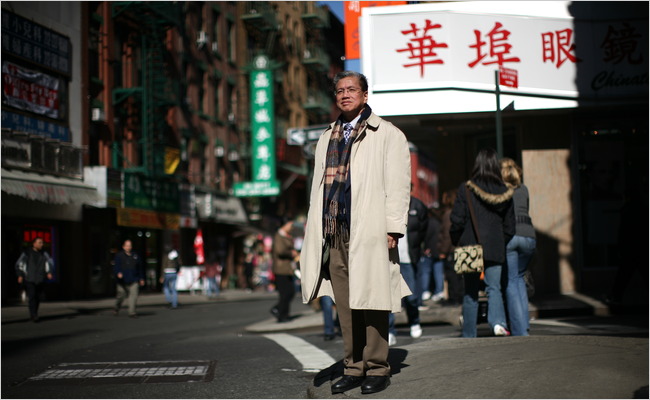
I grew up in Manhattan’s Chinatown. My family speak Toisanese (or Taishanese), which is a version of the more commonly known Cantonese. As far as I knew, everyone in Chinatown spoke either Canton or Toisan, or both. But not Mandarin.
Now that elusive gaw-gnui is taking over as the language of Chinatown, thanks to parents pushing their kids to learn it in order to advance in the world. With China growing in influence every day, it’s only natural for our kids to speak the language, so to speak. Even the local Chinese school offers more Mandarin classes than Cantonese.
But what about the older generations who continue to speak Canton and only Canton? Apparently, they’re going to have to readjust everything from where they shop to where they eat. Mr. Wong says when he enters a store where the staff speaks only Mandarin, he must try someplace else. Another Canton speaker, Jan Lee, says he can no longer order food from East Broadway, where a lot of the newer, Mandarin-speaking immigrants are settling. “They don’t speak English; I don’t speak Mandarin. I’m just as lost as everyone else.”
My family moved out of Chinatown eight years ago. Each time I go back to visit, the place evokes memories — memories I am going to have to hold onto, for my childhood home has changed in so many ways. Right down to the language I grew up with.
NOTE: 8Asians.com is a community, and we thank you for being a part of it. While we welcome and appreciate differences in opinion, if you're rude or you're promoting spam, we have a right to edit or delete your comment. Read our comment policy for more information.
If you see a comment that violates the 8Asians.com comment policy, you may flag the comment by mousing over the comment and clicking "FLAG."
Chinese dialects are dying all over the place. In Taiwan many youth can only listen to Taiwanese but can't speak it well, and many of the Hakka minorities can't even understand spoken Hakka anymore. Mandarin is the universal Chinese language, and despite efforts to preserve the dialects, the future is obviously Mandarin-centric. Cantonese culture is much stronger than most other dialects, so I won't be fearing its disappearance. However, it's influence is waning. In the past, the HK Pop culture rule the Chinese world - everyone love the 4 Sky Kings and try to learn Cantonese. Nowdays, the tables has turned and if a HK entertainer want to make it big, he or she has to make it in Taiwan with mandarin-based songs and acting roles (making it big in Taiwan = making it really big in China). No one watches HK drama or listen to Cantonese songs anymore. That's the way it is.
That seems to be the case in Hong Kong as well -- I only speak Mandarin, but I was able to get around Hong Kong without a problems because all the cabbies seemed to at a minimum understand. (This was right before the Olympics in Beijing.) Apparently this wouldn't be the case if I went even a couple years before that.
Feb 15: (Seattle, WA) Pork Filled Players Enter The Year of the Dragon Spam*O*Rama
Feb 16: Adam WarRock and Kirby Krackle: West Cost Tour Dates!!!
Feb 17: (Los Angeles, CA) All My Sons
Feb 18: (Stanford, CA) Stanford’s 16th Listen to the Silence Conference
Feb 25: (Los Angeles, CA) Past Present I Future Imperatives: Queer Space Time
Apr 30: (Sacramento, CA) California Asian Pacific Islander Policy Summit 2012: iAdvocate