
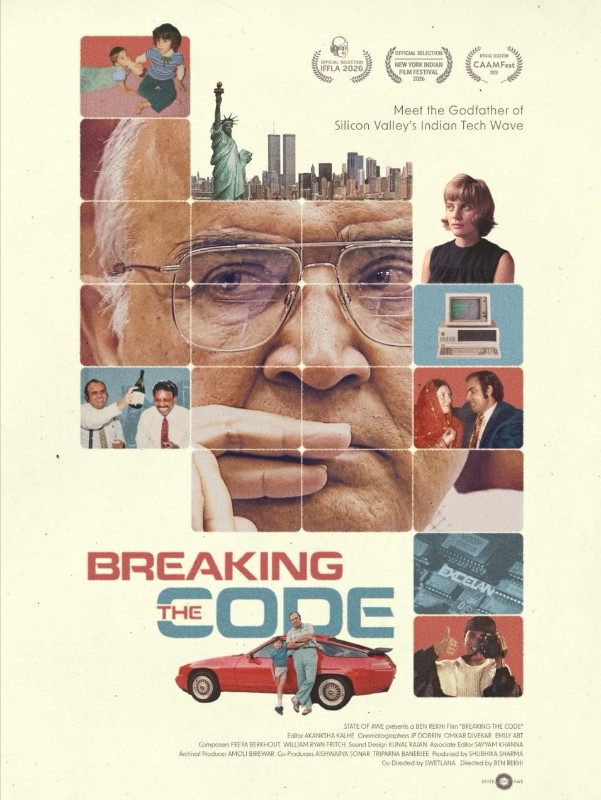
 While looking through the CAAMFest 2026 online guide, the documentary Breaking the Code, caught my eye. After seeing the film, I regret not being able to see the film in-person, especially since the subject of the film, Kanwal Rekhi and the filmmaker BenRekhi (his son), were in attendance for the post-screening Q&A.
Overview and Recommendation
“Kanwal Rekhi was the first Indian American founder and CEO to take a venture-backed company public on NASDAQ in 1987. He has mentored hundreds of aspiring businessmen through the IndUS Entrepreneurs (TiE), a global network for Indian entrepreneurs he co-founded. People call him the “Godfather of Silicon Valley’s Indian Mafia.”
Every Indian American should watch this documentary. Every Asian American and all Americans working in tech should watch this film. I work in tech in Silicon Valley and love learning about the history of tech. I consider PBS’s ‘Triumph of the Nerds’ the best three hours of television ever produced. Often I attend talks locally in Mountain View at the Computer History Museum. Steven Levy’s ‘Hackers: Heroes of the Computer Revolution’ is a great account of the early days of computing.
Discussion (some spoilers)
Breaking the Code not only chronicles the Rekhi’s rise in the tech/business world, but also a memoir of Kanwal Rekhi, his love story and inter-racial marriage with a white American woman, Ann. He corresponded with her for years as Parker penpals prior to meeting in person. Later, he cared for her during her cancer. The movie shows Rekhi’s reflections on her periods of depression due to her being abused by her stepfather as a child. Breaking the Code also directly exposes the racism and ignorance in America and one man’s efforts to level the business playing field.
I personally had never heard of Kanwal Rekhi until I came across this film, nor the company he founded and took public, Excelan. I have heard of Novell, which eventually acquired Excelan. Rekhi would eventually become second in command at Novell, which at the time, was the second largest software company in the world after Microsoft.
Kanwal Rekhi as an Early Pioneer
The documentary chronicles Rekhi from his early days as a child, to a student at a new Indian Institute of Technology (IIT) campus, to attending graduate school at Michigan Technological University (MTU).
The documentary reminds us that back in the 1960s, there were very few Indians coming to the United States for graduate school. Indians in IT/technology were far and few between. Indians did not have the reputation of Indians today. Nor were there Indian executive like today – Microsoft & Satya Nadella, Alphabet (Google) & Sundar Pichai, Adobe & Shantanu Narayen, and IBM & Arvind Krishna, to name a few. When Rekhi aced his first exam, he was accused by his professor of cheating and for his second exam, his professor stood over him and watch him take his exam.
After graduating from MTU, Rekhi had a few jobs in Florida and in California and was passed over to be promoted to becoming a manager (sound familiar?). His bosses would want to keep him as an engineer because he was so good at his job. Those bosses promoted a less experienced and qualified white colleague instead. Rekhi had ideas and ambition and was entrepreneurial, so left his safe job to start Excelan with his friends and eventually take the company public. And as stated before, Novell eventually acquired Excelan. Typical for those times, Rekhi eventually was passed over for the top job at Novell. He then concentrated his efforts on building the Indian American entrepreneurial network so that other Indians wouldn’t have to have struggled as much as he had.
The Indus Entrepreneurs
In 1995, Rekhi co-founded TiE, The Indus Entrepreneurs, “a nonprofit support network to provide advice, contacts, and funding to Indian Americans hoping to start businesses.” Having lived in the San Francisco Bay Area/Silicon Valley since 1999, I am aware of TiE and their annual conference in Silicon Valley. Still, I had never known about Rekhi. For Tie alone, Rekhi should be more well known!
In fact, I cannot think of an equivalent influential organization like TiE for Taiwanese, Chinese, Korean or other AAPI communities. The fact that TiE exists could be one of the major reasons why Indian Americans have thrived as business and technology leaders in the United States relative to other Asian American communities (though I have some other ideas on that subject that in the future I will need to formulate more cohesively )
After watching this film, I thought about my friend Jane Hyun and her book, Breaking the Bamboo Ceiling; my blog post on a study on Americans expecting their business leaders to be white, and Morris Chang founding TSMC after hitting the bamboo ceiling at Texas Instruments and how far Indian Americans have come since the 1960s in the United States.
Some Surprises
What surprised me the most was how candid the documentary is, specifically in regards to Rekhi’s wife Ann. It shows her cancer treatments. Rekhi discusses Ann’s abuse as a child and her periods of depression. In Chinese/Taiwanese culture, airing the family “dirty laundry” would be looked down upon or at least not to be expected. It was refreshing to learn about Ann’s physical and mental health issues. Both of which need to be destigmatized broadly in many if not all Asian American communities.
I think this documentary would be a pretty big eye opener for all Americans working in tech, and resonate with Asian Americans and very heartwarming for Indian Americans.
How can you watch the film?
As for distribution, the documentary is heading to a few more festivals on the circuit (NYIFF on May 30th, and some others that will be announced). The filmmaker is working with sales agents to secure distribution as we speak,aiming for the Fall. I hope this film gets wide distribution like on PBS, much like Invisible Nation.
Indian Institutes of Technology
As an aside, the Indian Institutes of Technology have become so well known by the early 2000’s that 60 Minutes had done a segment on them back in 2003:
“With a population of over a billion people in India, competition to get into the IITs is ferocious. Last year, 178,000 high school seniors took the entrance exam called the JEE. Just over 3,500 were accepted, or less than two percent.”
Personally, I have worked with IIT graduates. I launched Adobe’s first application that was fully engineered by Adobe India. Some of those extremely talented engineers graduated from IIT.