
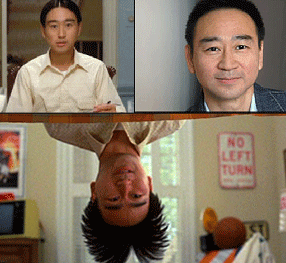
I was just driving home from work when I heard this National Public Radio (NPR) piece on (listen/read at): “Long Duk Dong: Last of the Hollywood Stereotypes?” and knew I had to blog about this right away. In “Sixteen Candles,” Japanese-American Gedde Watanabe plays Long Duk Dong.
“Long Duk Dong is the creation of writer-director John Hughes, whose films — The Breakfast Club, Pretty in Pink, Ferris Bueller’s Day Off — enshrined a Hollywood-heightened image of a suburban high school near you. Geeks, jocks, cheerleaders, kids desperate to find an in with the popular crowd — they were the standard character set. In real American schools, Long Duk Dong gave the mean kids new material. “Every single Asian dude who went to high school or junior high during the era of John Hughes movies was called ‘Donger,’” says Eric Nakamura. Nakamura and Martin Wong co-founded the magazine Giant Robot, which covers Asian and Asian-American pop culture. “If you’re being called Long Duk Dong,” Wong explains, “you’re comic relief amongst a sea of people unlike you.” Worse, says Nakamura: “You’re being portrayed as a guy who just came off a boat and who’s out of control. It’s like every bad stereotype possible, loaded into one character.” Nakamura and Wong say that before “The Donger” came along, they got called “Bruce Lee” at school. That wasn’t so bad: At least Lee, the martial-arts star, could kick ass. Sixteen Candles stole even that limited pleasure — and Asian-American guys focused their frustration on the actor who played Long Duk Dong. After all, he was one of them: born in the U.S.A.”
I’ve blogged about “yellow face” performances perpetuating bad stereotypes of Asians/Asian-Americans before in movies before, but this was the first ever piece on the radio I’d ever heard regarding Asian-American male actors and bad stereotypes. I also blogged recently about how that a Hollywood pioneer actor was an Asian, before Hollywood took a big step backwards in stereotyping Asians and Asian-Americans.
To be honest, I’ve never actually watched the 1984 John Hughe’s film, “Sixteen Candles” – maybe caught bits and pieces of it on TV (I have seen and did like The Breakfast Club). I was in the 8th grade when that movie came out, and although I lived in Western Massachusetts where very few Asian-Americans lived, I was never called Long Duk Dong or ‘Donger.’ I was however called Bruce Lee or asked if I knew karate while growing.
(Here are some other clips with Long Duk Dong in Sixteen Candles: “What’s happening hotstuff?“and “Very clever dinner.“)
When I was a freshman in high school, I had a locker next to this “jerk” (to put it mildly), who often did call me “Mr Miyagi” or “Daniel-san” or would say, “Wax on, wax off” when we were at our lockers (though calling me Daniel-san never made sense to me since Daniel’s character was white). If you didn’t catch the reference, this would be from the 1984 movie, “The Karate Kid.” So I could totally identify with the NPR segment about being tormented in high school through a bad Asian-American stereotype (ok, tormented may be too strong of a word).
The segment goes on to interview Gedde Watanabe, and he discusses his naivite at the time when taking the role (his first “big” Hollywood break), and how to this day, people recognize him as the actor who played Long Duk Dong and mimic his character in front of him. At the time of the film, Watanabe was often also accosted by Asian-Americans in public when recognized.
The NPR concludes the segment that there are now more roles for Asian-American men in Hollywood, but no breakout star. The closest the Asian-American community has as a “star” is John Cho – who is best know for playing Harold in the stoner comedy Harold & Kumar Go to White Castle and in an upcoming sequel Harold & Kumar Escape from Guantanamo Bay (in theaters April 25th).
I was really glad NPR did a dedicated segment on Long Duk Dong as part of their on-going series “In Character” (“Great characters: What makes them? What does it take to create them? Why do they matter? NPR’s In Character series joins with readers to explore these questions.“). The segment made me think, laugh, as well as made me angry (as in Angry Asian Man – I wonder if Phil Yu will blog about this the NPR segment now…)
NOTE: 8Asians.com is a community, and we thank you for being a part of it. While we welcome and appreciate differences in opinion, if you're rude or you're promoting spam, we have a right to edit or delete your comment. Read our comment policy for more information.
If you see a comment that violates the 8Asians.com comment policy, you may flag the comment by mousing over the comment and clicking "FLAG."
I remember watching an asian girl get sexually assaulted in high school by several caucasian guys. i should have done something. it was after school in the school yard with many onlookers. no one did anything.
another asian girl in college got raped by a caucasian guy. i remember these but i don't know how it affects me exactly. certainly affected the girls badly.
The policemen that guarded the subway turnstiles in NYC often told me that I looked like the guy from 'Gung Ho'. Gedde Watanabe plays the Japanese manager/executive working in an auto plant in the US. I was in 7th grade so I would just laugh and say 'do you want my autograph'. I had no other way of defending myself psychologically. This happened on a regular basis after school.
During the day, kids would come up to me and pull their eyes back. 'Ching Chong Ching Chong' they would make these noises. Most of the time it's kids from other grades/classes. I learned quickly that there was something wrong with me. There was something about me that's always comical to the other kids even if I sit perfectly still.
None of my friends would bother defending me. Many would tell me that is how asians looked and sounded. Some would pull their eyes back and make the 'ching chong ching chong' sounds in front of me. I didn't know I was a slanted eyed person with strange sounds coming out of me until 7th grade.
I remembered only 2 or 3 girls would talk to me like a normal human being. Even then it was rare. I would see groups of girls laughing together as they decide whether or not to ask me some questions as another girl pulls her away from taunting me.
Whether it's cause or effect or coincidence, I am much older now and have been in treatment for depression, had suicide ideation, body dysmorphic disorder and obsessive compulsive disorder.
I am learning to do well in spite of.
I remember watching an asian girl get sexually assaulted in high school by several caucasian guys. i should have done something. it was after school in the school yard with many onlookers. no one did anything.
another asian girl in college got raped by a caucasian guy. i remember these but i don't know how it affects me exactly. certainly affected the girls badly.
The policemen that guarded the subway turnstiles in NYC often told me that I looked like the guy from 'Gung Ho'. Gedde Watanabe plays the Japanese manager/executive working in an auto plant in the US. I was in 7th grade so I would just laugh and say 'do you want my autograph'. I had no other way of defending myself psychologically. This happened on a regular basis after school.
During the day, kids would come up to me and pull their eyes back. 'Ching Chong Ching Chong' they would make these noises. Most of the time it's kids from other grades/classes. I learned quickly that there was something wrong with me. There was something about me that's always comical to the other kids even if I sit perfectly still.
None of my friends would bother defending me. Many would tell me that is how asians looked and sounded. Some would pull their eyes back and make the 'ching chong ching chong' sounds in front of me. I didn't know I was a slanted eyed person with strange sounds coming out of me until 7th grade.
I remembered only 2 or 3 girls would talk to me like a normal human being. Even then it was rare. I would see groups of girls laughing together as they decide whether or not to ask me some questions as another girl pulls her away from taunting me.
Whether it's cause or effect or coincidence, I am much older now and have been in treatment for depression, had suicide ideation, body dysmorphic disorder and obsessive compulsive disorder.
I am learning to do well in spite of.
I got called "Wang Chung" by some idiot in junior high. I didn't see _Sixteen Candles_ till I was much older. I can definitely understand the criticisms of the Long Duk Dong character, but I also can't fault Gedde Watanabe for grabbing one of the few Asian parts in a major motion picture available at the time.
Feb 15: (Seattle, WA) Pork Filled Players Enter The Year of the Dragon Spam*O*Rama
Feb 16: Adam WarRock and Kirby Krackle: West Cost Tour Dates!!!
Feb 17: (Los Angeles, CA) All My Sons
Feb 18: (Stanford, CA) Stanford’s 16th Listen to the Silence Conference
Feb 25: (Los Angeles, CA) Past Present I Future Imperatives: Queer Space Time
Apr 30: (Sacramento, CA) California Asian Pacific Islander Policy Summit 2012: iAdvocate
[...] saw this on another blog–8Asians.com. NPR yesterday produced a show that covers Asian American male media stereotypes with special [...]
[...] finally got around to seeing Sixteen Candles. I had blogged back In March about NPR’s story on Long Duk Dong: Last of the Hollywood Stereotypes?, but had never actually seen the movie (to the surprise of many). I saw that Sixteen Candles was [...]
[...] all reminds me of the 1986 movie Gung Ho staring Michael Keaton and Gedde Watanabe about a fictitious Japanese auto manufacturer — Assan Motors Corporation — taking over [...]
[...] Adrian Tomine, accompanied a piece on stereotypes of Asian American men in media, also blogged by John over at the excellent 8Asians. And it does a good job of describing Tomine’s mixed feelings about the [...]
[...] role for an Asian-American or a Hispanic would be in a movie about mean high school kids. Another Sixteen Candles type role? The Daughter thinks it will be for a nerd or for someone playing the piano. Anyone else care to [...]