Dutch couple returns Korean adopted daughter cause she “doesn’t fit”

A Dutch diplomat and his wife dumped their eight year old Korean adopted daughter on Hong Kong officials claiming that she was unable to “fit in” with the family. Not surpringly, the couple’s horrific act has made headline news around the world and ignited a wave of international anger.

Raymond Poeteray, currently the vice consul at the Dutch Consulate General in Hong Kong, and his wife adopted baby Jade from South Korea in 2000 at the age of four months. The couple believed themselves to be infertile at the time. Since then, the couple was able to conceive two biological children. The couple claims that Jade was never able to intergrate into their culture or family and that doctors had diagnosed her with a “severe fear of bonding”. A nanny who claims to have worked for the couple tells a very different story. She said the couple treated Jade very differently than their two biological children and that the diplomats wife rarely hugged the little girl.

This story is horrific and outrageous! What kind of monsters must these people be to mindlessly give away the child they had been raising for nearly eight years with no regard to her future well being. This couple had the girl from the time she was four months old. It’s not like she was a fully formed child with possible abandonment issues. Any issues the girl had with bonding and building relationships is a direct result of the care, or lack there of, given to her by her adopted parents. The diplomat and his wife scared her and ruined her and have now decided that she is no longer wanted. Isn’t there some sort of child-endangerment law that these people can be prosecuted for?

Inter-racial adoption is already a controversal and complex matter, it doesn’t need this type of publicity to complicate things even further.

Posted in Current Events | 6 Comments

Are Filipinos Asian or Pacific Islanders?

8 Asians was recently asked the question: Why do some Asian-Americans say that Filipinos are actually Pacific Islanders, and not really Asian?

Our fearless leader Ernie threw the question out to the teaming masses and the answer we came up with… well, lets just say it was a mighty group effort.

Ben started us off by very wisely pointing out that the Philippines was, in fact, a set of islands in the Pacific Ocean.

I contributed a few nerdy facts about recent genetic analysis that indicates greater genetic migration/diversity amongst Southeast Asians (SEA) and Pacific Islanders vs. East Asians (EA). The same genetic analysis also seems to indicate greater Y chromosome similarities between SEAs and Africans than EAs and Africans.

Efren, Asian-American studies aficionado, set us all straight by educating us on the 1965 Immigration Act and its classification of Filipinos as Asian rather than Pacific Islanders.

According to how the 1965 Immigration Act was set up in the US, which is how these distinctions were made in the first place, Filipinos are considered Asian instead of Pacific Islander based on histories of migration, isolation, etc. The Philippines, because of its close proximity to the Asian continent, was designated as being part of Asia. Also, because of the extensive history of interactions between the Philippines and the Asian continent, including China, Southeast Asia, Indonesia, India, etc., the Philippines have a lot more similarities between those cultures than the cultures of the Pacific Islands.

Because of the relative lack of outside contact and relative isolation culturally, the Pacific Islands (Guam, American Samoa, Hawai’i, and the other island nations and territories in the South Pacific), Pacific Islanders are considered to be separate, and has been argued successfully, at least for native Hawaiians, that their experiences of living in the United States, is more akin to American Indians/Native Americans, rather than Asians, due to histories of subjugation, forced take-over, cultural and population genocide.

And there you have it folks. The 8 Asian stream-of-conscious answer to the question “Are Filipinos Asian?”. And it only took us about 15 email exchanges to get to this point.

What do you think about our answer?

Posted in Observations | Tagged , , | 81 Comments

Asian Guys and that One Long Pinky Fingernail

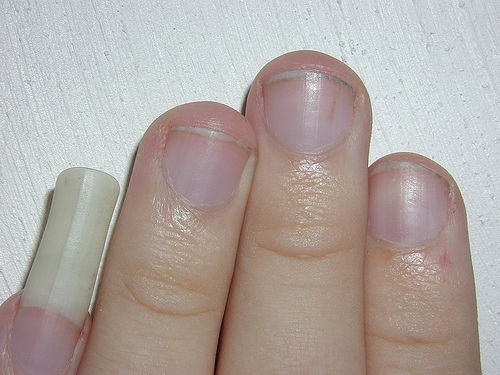
long pinky fingernail

One of the things that I’ve always wondered about, or at least, bugged the hell out of me is seeing Asian guys with one long pinky fingernail. My first boyfriend had it, and he claimed that when he was having sex with women that he would use it on them. Granted, we were both under 18 at the time, and I was completely in the dark about women’s anatomy, but the idea of having a fingernail anywhere near those parts just sounded rather painful to me, so I took that statement with a huge grain of salt.

I’ve seen it on lots of different men, from many different Asian countries, though it seems to be predominantly on guys who are from Southeast Asia, mainly Vietnam or the Philippines, though I’ve seen other guys with it from China, etc. No one bothered to explain why they had one to me, except for the sexual explanation.

Lo on behold, I was surfing The Straight Dope, a huge font of incredibly trivial (or necessary, depending on how you look at it), knowledge who got their staff to do a rather unscientific way of gathering reasons for this (namely, posting something on their message board). They proclaimed that it was primarily as a way to pick their nose and/or ears.

Ewww. At least it makes more sense, but I’ll probably think twice before I shake a guy’s hand if he has that long-ass pinkie fingernail.

However, I want to put it out there to see if there’s anyone who can prove me wrong, and show me what that fingernail is used for–and if you’re willing to admit you actually do use it for… bodily functions… uh, great.

Posted in Observations, WTF | Tagged , , , | 28 Comments

Video: Baun Mah’s “A Chink in the Armour”

Somehow, with all the embedded video clips of interracial dating movies and skits about Asian America, I missed Baun Mah’s 2005 short-film A Chink in the Armour, a kinda-sorta documentary about Chinese stereotypes and the tests he conducts as to whether Chinese Canadians (it takes place in Toronto) really live up to them.

Thankfully, Baum doesn’t take himself too seriously. While he has the required interviews with authors and professors, he also rounds up a bunch of Chinese volunteers to see whether all Asians really are good at math, drive badly, turn bright red when drinking or know kung-fu. (Seriously, even if you tire of the movie you’ll want to at least fast-forward it to the 21 minute mark. Trust me.)

(Hat tip: Scott Schiller, who is Canadian)

Posted in Entertainment | 4 Comments

For Chinese-Americans, Schools Earn the Prize

This New York Times article “For Chinese-Americans, Schools Earn the Prize“, was published back in early November, but I just got this sent to me a few days ago and thought it was interesting:

“LAST February, Jerry Yang and his wife, Akiko Yamazaki, pledged $75 million to Stanford University for a variety of programs. Two-thirds of their gift will go to build a new environment and energy site. The balance will go to the medical school. Like other prominent Chinese-Americans, Mr. Yang, who is the chief executive of Yahoo, is loyal to his and his wife’s alma mater and enthusiastic in its aid. The fact that the beneficiary is a university is emblematic of what Chinese-Americans have accomplished as they have moved into the realm of multimillionaires and billionaires. Influenced by the Confucian respect for the importance of study, they have viewed American universities as the way up the ladder to success. And now second- and third-generation Chinese, and even some of the newer immigrants, are broadening their reach beyond education and the arts to social services. Or they try to wrap both agendas together — like helping poor Chinese get a better education in the United States….In Ms. Cheng’s view, the traditional Chinese in America have not been too philanthropic. “There is no tradition of philanthropy, and many people are helping family members or saving money,” she said. “But that is beginning to change.” “

This was interesting to read, since I had posted in “WSJ: The Revolution of Chairman Li” about Li Ka-shing, Asia’s richest man, trying to build a tradition of philanthropy. I can see why Chinese-Americans (as well as Taiwanese-Americans: note: Jerry Yang was born in Taiwan) would donate money to educational institutions, as a lot of their professional success is rooted in their education. It’ll be interesting to see the broadening of philanthropic efforts by the Asian-American community.

Posted in Current Events, Observations | 3 Comments

Grandma Master Flash

This is going ’round the interwebs already, but I figured what the hell? It’s a nice little Saturday post for you hung over folk partying late last night (or getting ready to go out today). Keep in mind: this woman is 71 years old!

Posted in Lifestyles, WTF | 7 Comments

Utada does a duet with… Ne-Yo?

Remember Utada? Fans of J-Pop would cut me in the face for asking that question, of course – Utada is the simply a moniker for Hikaru Utada, a New York born Japanese pop superstar. Fans – me included – were thrilled that she released her first American album Exodus in 2004, but it didn’t really make any waves in the United States: A mix of bad marketing, a conscious decision to alienate the American fans of her thriving J-Pop career (I’ve never seen her in a bikini for a music video, until now) and some shady production values (Bjork like electronica tracks mixed with two tracks from producer Timbaland at the end) had her peak at #160 on the US Billboard Charts. Honestly, I found myself playing her follow-up Japanese album ULTRA BLUE on my iTunes more often, and I don’t understand a word of Japanese.

Utada’s at it again, though, working on her untitled fifth Japanese-language studio album and second English album simultaneously. In addition, she just did a collaboration with R&B star Ne-Yo for his single, Do You.

Ne-Yo? The guy from “Sexy Love?” Really? At first I thought it was another misguided attempt at putting Utada in an R&B market, but from her website it looks like the single will be released in iTunes Japan only, as an attempt to promote Ne-Yo worldwide.

As for the song itself, here’s a YouTube video:

Hmmm. I’m not sure if I’m feeling this. Her voice is a little too… warbly. Sorry, Hikki, I like your stuff otherwise.

Posted in Entertainment | 2 Comments

Speaking of “Yellow Face”: David Henry Hwang

David Henry HwangAsianWeek’s recent review of infamous Yellow Face performance (which John blogged about earlier this week) seems particularly timely given that David Henry Hwang’s first new play in 10 years, Yellow Face, opened this week at the historic Public Theater in New York City. Reviews have been mixed thus far.

The quasi-biographic play is a self-analytic exploration of racial identity and politics. The play begins with the protaginist, simply called D.H.H, leading a protest against the casting of Jonathan Pryce as a Eurasian in the Broadway musical “Miss Siagon” – something that Hwang actually did do in the early 90s. D.H.H. eventually goes on to mistakenly cast a white man (believing him to be of mixed race) in an Asian role in his own play. Hilarity/drama ensues as D.H.H. tries to cover up his mistake and save his own reputation as a leader in the Asian-American community.

“The play is a mix of fact and fiction, in a mock stage documentary style, about a character based on me,”

I find it intriguing that David Henry Hwang, an artist that has played a pivotal role in the cultivation of the Asian-American identity, still grapples with the discussion and exploration of race.

“I think I’ve been struggling since the “Miss Saigon” incident back in 1990 to make sense of, how do you talk about the nuances of race, both the desire to get past race and the awareness that racism still exists? How do you balance those two? I found that by creating a character that I actually gave my name to, in a strange way it liberated me to make him a character. Many times with autobiographical characters in plays, it’s very difficult to have them be fully fleshed out, even someone like Tom in “The Glass Menagerie.” It’s kind of counterintuitive, but by naming him after myself he became more of a character. “

Has anyone had an opportunity to check this play out?

Posted in Entertainment | 2 Comments

70 Years Ago Today: The Rape of Nanking

70 years ago today, December 13th, 1937, the Nationalist China capital city Nanking fell to the Japanese. What ensued over the next few months is known as “The Rape of Nanking.” In today’s New York Times, the newspaper reviews the documentary, “Nanking” in the article titled “Giving Testimony on the Horror That Was Nanking“:

“Nanking” is a swift, incisive documentary about one of the lesser-known horrors of the 20th century: the 1937 Japanese invasion of the Chinese cityhttp://graphics8.nytimes.com/images/2007/12/12/arts/12nank600.jpg now called Nanjing, where more than 200,000 civilians and prisoners of war were slaughtered in a matter of weeks. The capital of the Republic of China at the start of World War II and the headquarters of the Chiang Kai-shek government, this attractive, cosmopolitan city of parks and thoroughfares was largely destroyed in what is known as the rape of Nanking. Though some Japanese scholars dispute the statistics determined after the war by the International Military Tribunal for the Far East, it is widely agreed that during the occupation in 1937 and 1938, more than 20,000 rapes were also committed by the rampaging Japanese Army. In its concentrated savagery, the catastrophe was comparable to the even more numerous mass murders in Rwanda in 1994.”

The definitive book, at least in English in the United States, was authored by Iris Chang, titled “The Rape of Nanking – The Forgotten Holocaust of World War II.” To understand the post-World War II underlying animosity between China and Japan, one has to understand that Japan has never fully acknowledged publicly, and especially in their school textbooks, the atrocities it committed to the Chinese, especially The Rape of Nanking. Unfortunately, mankind has not learned the lessons of history and has repeatedly waged war and genocide against each other many times over since Nanking.

Posted in Current Events, Observations | 42 Comments

Can’t We All Just Get Along? New research explores tensions between US’ largest ethnic groups

New American Media, the nations first and largest collaboration of ethnic news media, released the results of the first multilingual poll examining how the US’ largest ethnic groups feel about each other, as well as their attitudes on key elements of American society.  The goal of the poll is to create a basis to improve relationships between minority groups and spur better media coverage of ethnic communities.   

“We need to know what’s being whispered in our own backyards,” says Jeong. “We need a get-to-know-each-other campaign.” The first national poll of race relations among Asian Americans, African Americans and Hispanics from New America Media is a “starting point” in that campaign, says Jeong.The Korea Times, along with eight other major ethnic newspapers, signed on as a co-sponsor of the poll because ethnic media are increasingly becoming aware that it’s not enough just to cover their own communities.

“This is an extraordinary piece of information that can hopefully help our three communities to have a better understanding of each other,” said Pedro Rojas, La Opinión’s executive editor.“Wherever you live and work in the states today, and especially for us in California, learning from communities near us and around us is vital to growing,” says Anh Do, vice president of Nguoi Viet Daily News in Westminster, Calif., one of the oldest Vietnamese newspapers in the country and a sponsor of the survey.

Anyone who keeps abreast of race politics in America will not be suprised by the results from the poll.  Here are some quick highlights:

  • Predominantly immigrant communities – Hispanic and Asian – are more optimistic about their lives in America.  By contrast, 60% of African-Americans believe the American Dream does not work for them.
  • Racial tension between minority groups is rooted in a mistrust of each other.  44% of polled Hispanics and 47% of Asians are “generally afraid of African-Americans because they are responsible for most crimes.”  Meanwhile, 46% of Hispanics and 52% of African-Americans believe “most Asian business owners do not treat them with respect.”
  • Meanwhile, all three minority groups seem more trusting of whites than each other.  61% of Hispanics, 54% of Asians, and 47% of African-Americans would rather do business with whites than members of the other two groups.

Whooo!  If these poll results are an accurate reflection of race relations in the US, we minorities have a lot of work to do to build ties with other groups!  

You can read an executive summary, including more poll results, here.

On a slightly different note, I also found the polling methodolgy for this survey to be quite intriguing. 

The poll of 1,105 African American, Asian American and Hispanic adults was conducted by telephone during the months of August and September 2007. The sample was designed to be representative of the adult population of the three major racial and ethnic minorities in the United States. Hispanic respondents were interviewed in English or Spanish, and Asian American respondents were interviewed in English, Mandarin, Cantonese, Korean, Vietnamese or Tagalog. RDD (Random Digit Dialing) methodology was employed in areas of the country that have significant (10 percent or more) African American, Asian American and Hispanic populations.

It’s really exciting to see that the poll was offered in multiple languages.  It’s nice to include communities of people who typically get overlooked by pollsters due to language barriers.   

Posted in Current Events, Observations | Leave a comment

AsianWeek: The 25 Most Infamous Yellow Face Film Performances (Part 1 & 2)

http://www.asianweek.com/wp-content/uploads/2007/12/2_mickeyrooney.jpgThe San Francisco-based AsianWeek recently did a two-part story on “The 25 Most Infamous Yellow Face Film Performances (part 1, part 2)”  You ask, what is “yellow face”?:

 “It may be hard to believe, but there was once a time when Hollywood would routinely turn to non-Asian actors to portray Asian characters in films. Often, these “yellow face” performances both reinforced and embodied all the negative stereotypes — funny accent, slanted eyes, buck teeth, and enough “Orientalism” to send the yellow fever meter through the roof.”

I was glad to see that #2 on the list was Mickey Rooney as Mr. Yunioshi in Breakfast at Tiffany’s. Now I really liked this film (despite Mickey Rooney), but the first time I saw this movie, I *could not believe* the portrayal of Mr. Yunioshi by Rooney – I was disgusted. I found that Mr. Yunioshi’s character not be comic relief, but the very racist portrayal having nothing to do with the overall plot of the movie. (Note: I was also shocked to see George Peppard as the lead actor – I just remember him from the TV series, The A-Team !) If you’ve ever seen the movie, what are your thoughts on this? Am I over-reacting?

Posted in Discrimination, Entertainment, Observations | 12 Comments

Presidential Campaign Staff Diversity: Should it matter?

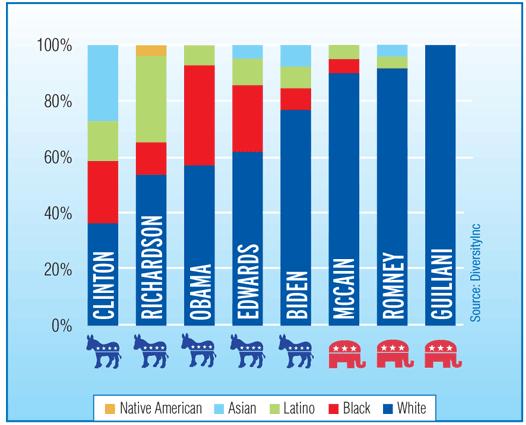
Presidential Campaign Staff Diversity

DiversityInc. recently took a look at the campaign staff diveristy of the leading presidential candidates. Considering that the democratic party has three diverse candidates (Hilary Clinton, Bill Richardson, and Barack Obama) to the republican’s big fat zero, it’s no surprise that democratic candidates would have greater staff diversity.

One could go on and on and try to make some sort of correlation between campaign staff diversity and a candidates’ ability to effectively lead an increasingly diverse America, but that angle has already been covered relentlessly. My main concern is whether staff diversity should even matter when evaluating a candidate? What information about a candidate’s ability to lead this country can be deduced by analyzing staff diversity?

As a corporate diversity officer I frequently get asked whether diversity representation numbers are a good indication of a company’s overall environment of inclusion. My response is “It’s not that straightforward.” On the one hand, staff representation is a nice shortcut – it tells you whether there are other diverse people in an organization. However, this doesn’t really tell you if the place is inclusive and if the leadership (in this case, the presidential candidates) really support an agenda that takes into perspective the needs of everyone in the organization (in this case, the United States of America). One assumes that a demographically diverse organization is also inclusive – but there are enough EEOC lawsuits out there to disprove this.

Would it be fair to say that since Hilary Clinton’s staff is more than 30% of Asian, she’s the best candidate for Asians? Probably not. It’s like saying that since Guiliana has NO minorities on his staff, he’s the worst candidate for minorities. Depending on your political leanings, you may actually feel this way. Nacht.

Posted in Politics | 6 Comments